130,000 Dots and the Afterglow of the Big Bang: On Tan Mu's No Signal
Roughly one percent of the static on an untuned television comes from the beginning of the universe. This is not a metaphor. When a cathode-ray tube loses its signal and the screen fills with the familiar blizzard of black and white, a small but measurable fraction of that visual noise is caused by cosmic microwave background radiation: photons released approximately 380,000 years after the Big Bang, when the universe had cooled enough for light to travel freely for the first time. These photons have been traveling ever since, their wavelengths stretched by the expansion of space from visible light into microwaves and radio waves, arriving at television antennas as an ambient hum indistinguishable, to the untrained eye, from interference. The rest of the static is mundane: electromagnetic noise from household electronics, thermal fluctuations in the antenna's own circuitry, stray signals from nearby transmitters. But that one percent is 13.8 billion years old. It has been traveling since before the Earth existed, before the Sun ignited, before the Milky Way coalesced from primordial gas. And it appeared, for decades, on the screens of living rooms around the world, mistaken for nothing.
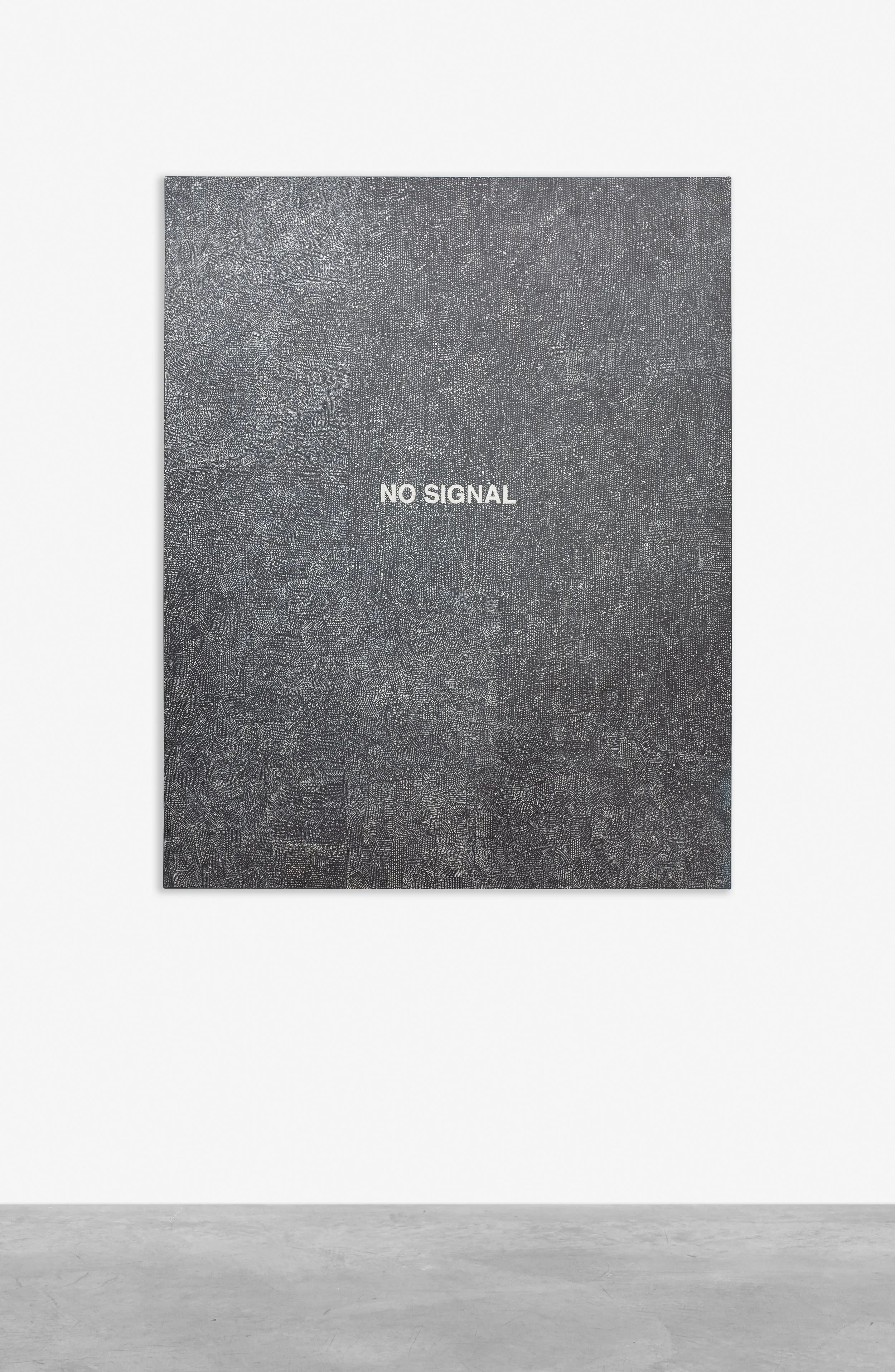
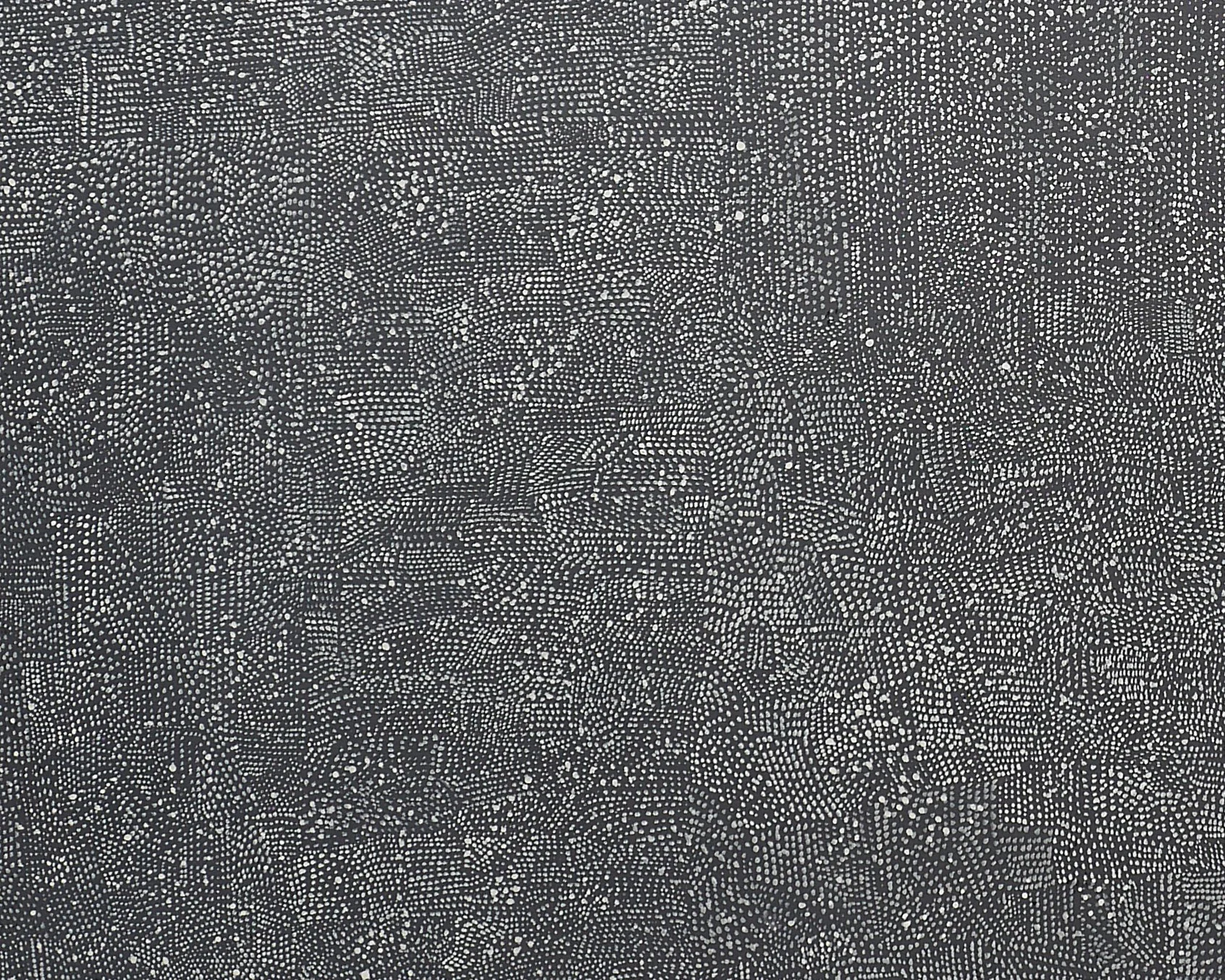
Tan Mu's No Signal (2019) is a painting of this static. Oil and acrylic medium on canvas, 152 by 122 centimeters, it depicts the snowfield of a television that has lost its signal. From across a room, it reads as a gray field, uniform and undifferentiated, the kind of image that a viewer might pass without stopping. From closer, structure begins to emerge: the gray resolves into thousands of individual marks, each one placed by hand. Move closer still, and the scale of the labor becomes apparent. There are approximately 130,000 dots on this canvas. Tan Mu placed them over the course of a week, one at a time, by hand.
The Week of Dots
The number matters. A painting of television static could be made in any number of ways: a sponge, a spray, a digital print. The decision to place 130,000 individual marks by hand over seven days is not an aesthetic choice in the ordinary sense. It is a temporal one. The painting embeds within itself a specific duration of sustained, repetitive attention. Each dot is a discrete act: the loading of the brush, the placement of the mark, the lifting of the hand, the return to the palette. Multiply this by 130,000 and you arrive at something closer to a performance than a technique. The painting is, among other things, a record of Tan Mu's body spending a week in a state of focused, repetitive labor, producing marks at a rate of roughly one every three to four seconds for eight to ten hours a day.
This places the work in a lineage that includes Roman Opalka's number paintings, in which the Polish artist spent his entire career painting consecutive numbers in white on increasingly lighter gray grounds, and On Kawara's Today series, in which each painting records a single date. In all three practices, the accumulation of discrete units over time produces a surface that is both an image and a document of its own making. But where Opalka and Kawara were concerned with the passage of time as such, Tan Mu's repetition is pointed at a specific subject. The 130,000 dots are not abstract units. They stand in for something. "The more than 130,000 dots on the canvas stand in for the blank spaces left by memory shutting down," Tan Mu has said. "They are not only visual elements but an attempt to capture the sensation of memory disconnection and to search for meaning and creativity within emptiness."
This statement introduces a biographical dimension that transforms the reading of the work. In 2019, the year No Signal was made, Tan Mu experienced partial memory loss following a freediving accident. The details are sparse, she has spoken about it in interviews but without clinical elaboration, but the consequence for the work is significant. The painting of a screen that has lost its signal was made by a person who had temporarily lost access to her own memory. The static is not a metaphor for disconnection. It is a formal analogue. The television and the painter shared the same condition: both were receiving noise where there had previously been information.
Signal, Noise, and the Architecture of Loss
There is a concept in information theory called the signal-to-noise ratio: the measure of useful information relative to background interference. In telecommunications, a high signal-to-noise ratio means clarity; a low one means degradation. At zero, the signal disappears entirely into noise. The screen goes to static. The title No Signal marks this zero point, but the painting itself complicates it. If one percent of television static carries the cosmic microwave background, then even at the zero point of human communication, something is still being transmitted. The noise is not empty. It contains, encoded within its randomness, the oldest signal in the universe.
Tan Mu's sensitivity to this paradox, that apparent emptiness can contain profound information, is not incidental. It runs through her entire practice. The submarine cables she later painted in the Signal series are invisible infrastructure: world-shaping systems that most people never see or think about. The quantum computers she has depicted in other works operate at temperatures approaching absolute zero, in conditions so extreme that the machines must be shielded from the thermal noise of a human body standing nearby. Again and again, Tan Mu gravitates toward systems in which the most consequential information is carried by the most inconspicuous means, in environments where the signal is barely distinguishable from the noise.
In No Signal, this preoccupation takes its most intimate and personal form. The dots do not represent data packets traveling through fiber-optic cables at the speed of light. They represent the contents of a mind that has temporarily gone dark. The painting is not about the cosmic microwave background, though it contains it. It is about the experience of losing access to oneself and searching, dot by dot, for a way back.
The Body as Receiver
Tan Mu has described herself as "a human printer," a phrase that invites misreading. It might suggest a passive role, the artist as mere output device for externally sourced data. In practice, the opposite is true. Tan Mu's research process involves sustained physical engagement with the subjects she paints. For the Signal series, this means freediving to depths where submarine cables run, entering the medium that her paintings depict. For the quantum computer works, it means studying the engineering principles of superconducting qubits. For No Signal, the engagement was involuntary: the subject imposed itself on the artist through the disruption of her own neurological hardware.
The freediving accident that preceded this painting is worth dwelling on, not for its biographical drama but for what it reveals about the relationship between body and information in Tan Mu's practice. Freediving requires the deliberate suppression of the body's panic responses. At depth, the diver's lungs compress, oxygen levels drop, and the brain must continue to function under conditions of increasing deprivation. The body becomes an instrument operating at the edge of its capacity, processing information (pressure, orientation, light, time) with diminishing resources. When this instrument fails, as it did for Tan Mu, the result is not a dramatic collapse but a quiet absence: memories that should be there are simply not. The screen goes to static.
This somatic dimension distinguishes No Signal from other paintings that address television or broadcast media. Whereas artists like Nam June Paik manipulated the television as an object, stacking monitors and distorting signals to critique the apparatus of mass communication, Tan Mu's painting bypasses the apparatus entirely. There is no television in the painting. There is no frame, no screen, no hardware. There is only the static itself, translated from electronic signal into oil paint, from pixels into dots, from the screen's impersonal flicker into the painter's hand. The television has been absorbed into the body of the painter. The static has become personal.
From Disconnection to Network
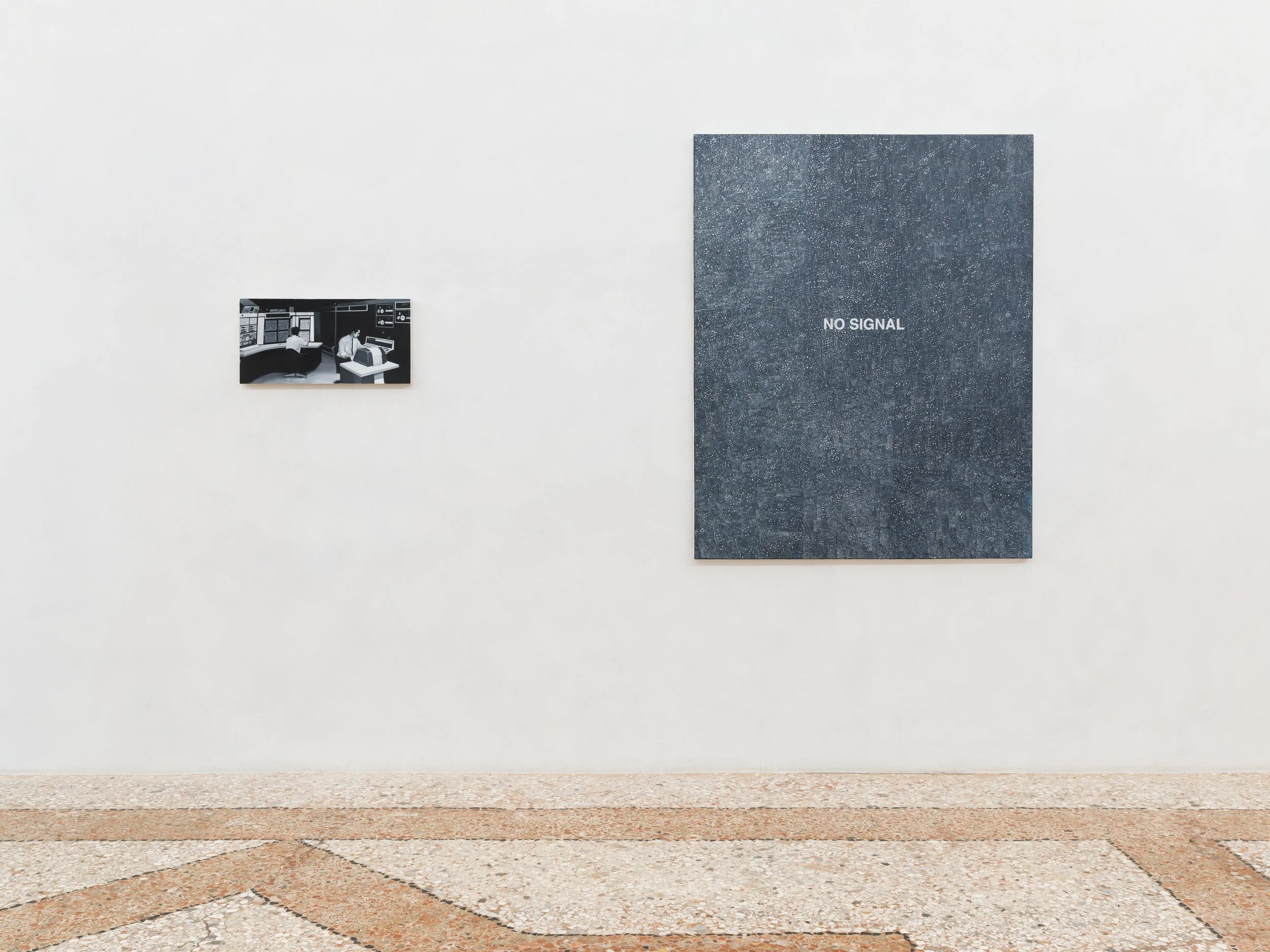
No Signal was made in a midtown Manhattan studio in 2019. It was shown three years later at Peres Projects in Milan as part of the Signal exhibition, where it hung alongside the submarine cable paintings that it had, in a sense, predicted. The curatorial placement was precise. Positioned among the luminous constellations of the Signal series, with their thick accumulations of paint marking cable landings across the Pacific and Caribbean, No Signal read as the series' origin point: the moment of disconnection that catalyzed the artist's subsequent investigation of global connectivity.
Tan Mu herself has drawn this connection. "Alongside Loading... and Off, No Signal is closely connected to the Signal series," she has said. "In the Signal series, I also use large numbers of dots to represent data packets traveling through submarine cables. These dots reflect data flow in the digital age but also point to collective human labor and global interconnectedness. In No Signal, the dots signify mental emptiness and information loss, serving as a metaphor for memory disconnection."
The formal continuity is striking. The same mark, a small, loaded dot of paint, serves opposite functions across the two bodies of work. In the Signal paintings, each dot is a landing station, a node of connection, a point where information enters or leaves the ocean. In No Signal, each dot is an absence, a placeholder for information that has been lost. The mark is the same. The meaning inverts. This is not ambiguity for its own sake. It is a rigorous formal argument about the nature of communication systems. A dot on a map is a dot on a map whether it marks a cable landing or a missing memory. The infrastructure of connection and the infrastructure of loss share the same visual grammar. The difference is not in the mark but in the network that gives it meaning.
What the Static Contains
A generation is now reaching adulthood that has never seen television static. The analog signal that produced the CRT snow of No Signal has been almost entirely replaced by digital broadcast, which does not degrade into static but into pixelated blocks or, more commonly, a blank screen with an error message. The static that Tan Mu painted in 2019 is, in this sense, already historical. It belongs to a specific technological moment, the era of analog broadcast, that has ended. The painting documents not just an image but a phenomenon that is disappearing from lived experience.
This gives the work an archaeological quality that deepens with time. As analog static recedes from common memory, No Signal will increasingly function as a record of a sensory experience that is no longer available. The painting preserves not just how the static looked but, through the labor of its 130,000 dots, how it felt: the ambient, indeterminate, faintly hypnotic quality of a screen that is receiving everything and nothing at once.
And within that everything, the one percent. The cosmic microwave background that arrives at the antenna alongside the noise of toasters and cell phones and power lines, carrying information from the first moments of the universe. It was there on every untuned television ever manufactured, from the first commercial sets of the late 1940s through the final analog broadcasts of the 2010s. Nobody watched it on purpose. Nobody needed to. It was simply there, mixed into the noise, the oldest light in the universe arriving in living rooms and being mistaken for nothing.
Tan Mu's painting does not rescue this signal from obscurity. It does something more subtle. It holds the static in suspension, the cosmic and the personal, the ancient radiation and the recent memory loss, the universal and the intimate, and asks the viewer to look at it long enough to notice that the noise was never empty. That the blank spaces are not blank. That even at the zero point of signal, something is still being transmitted, if you have the patience and the attention to receive it.