The Machine That Reaches for the Beginning: Tan Mu's Large Hadron Collider and the Scale of Collective Seeing
One hundred meters below the surface of the earth, in a tunnel that circles twenty-seven kilometers through the bedrock beneath the Swiss-French border, two beams of protons travel in opposite directions at 99.9999991 percent of the speed of light. They complete eleven thousand circuits per second. When they collide, the temperature at the impact point exceeds that of the center of the sun by a factor of one hundred thousand. For a fraction of a nanosecond, conditions replicate the universe roughly one trillionth of a second after the Big Bang. The machine that makes this possible cost approximately thirteen billion dollars to build and employs roughly thirteen thousand physicists, engineers, and technicians from over seventy countries. It requires a power grid that could light a small city. Its cryogenic system circulates superfluid helium at 1.9 Kelvin, colder than outer space. It is the most complicated apparatus ever constructed by human beings. And it exists, primarily, to study objects so small that they cannot be seen.
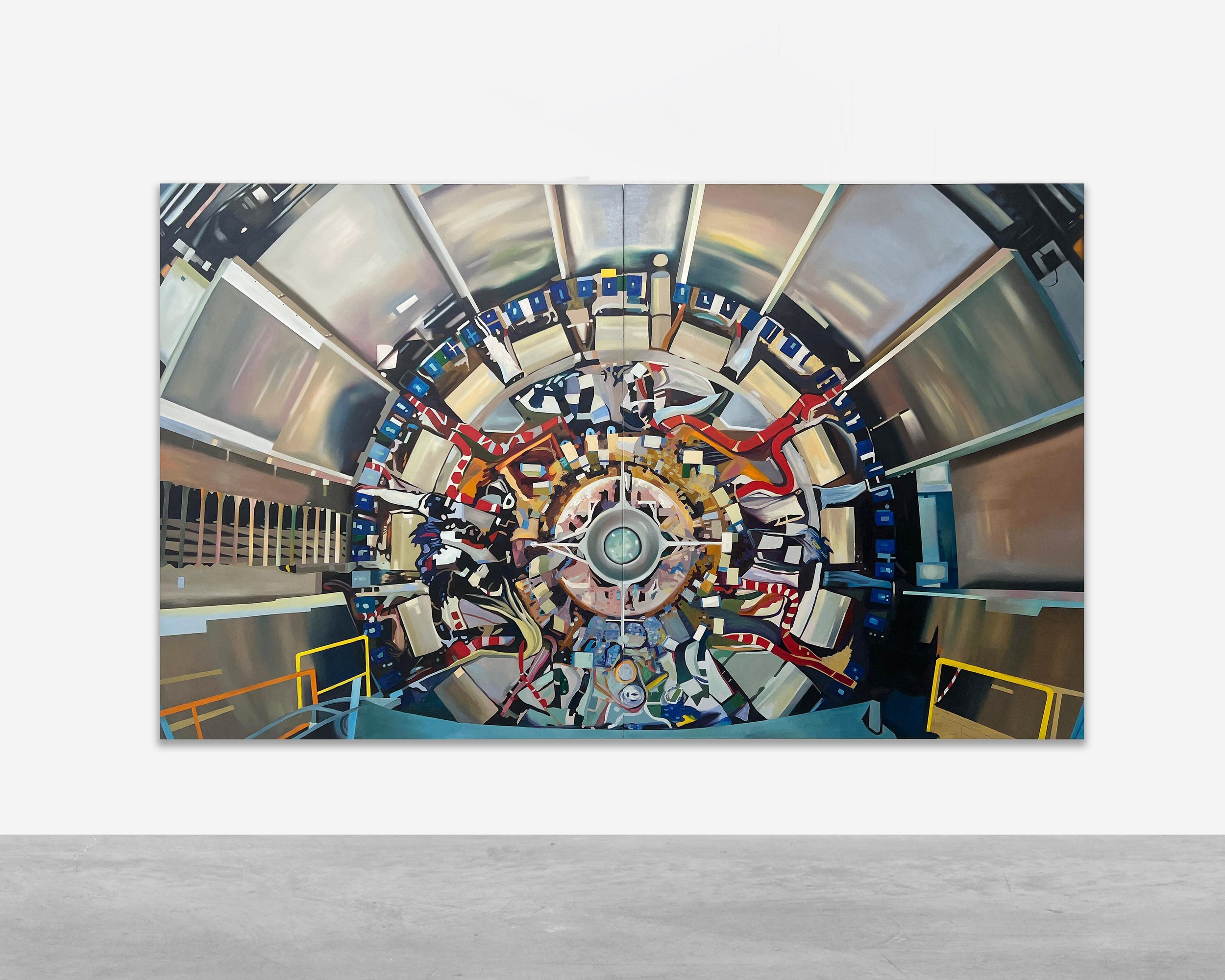
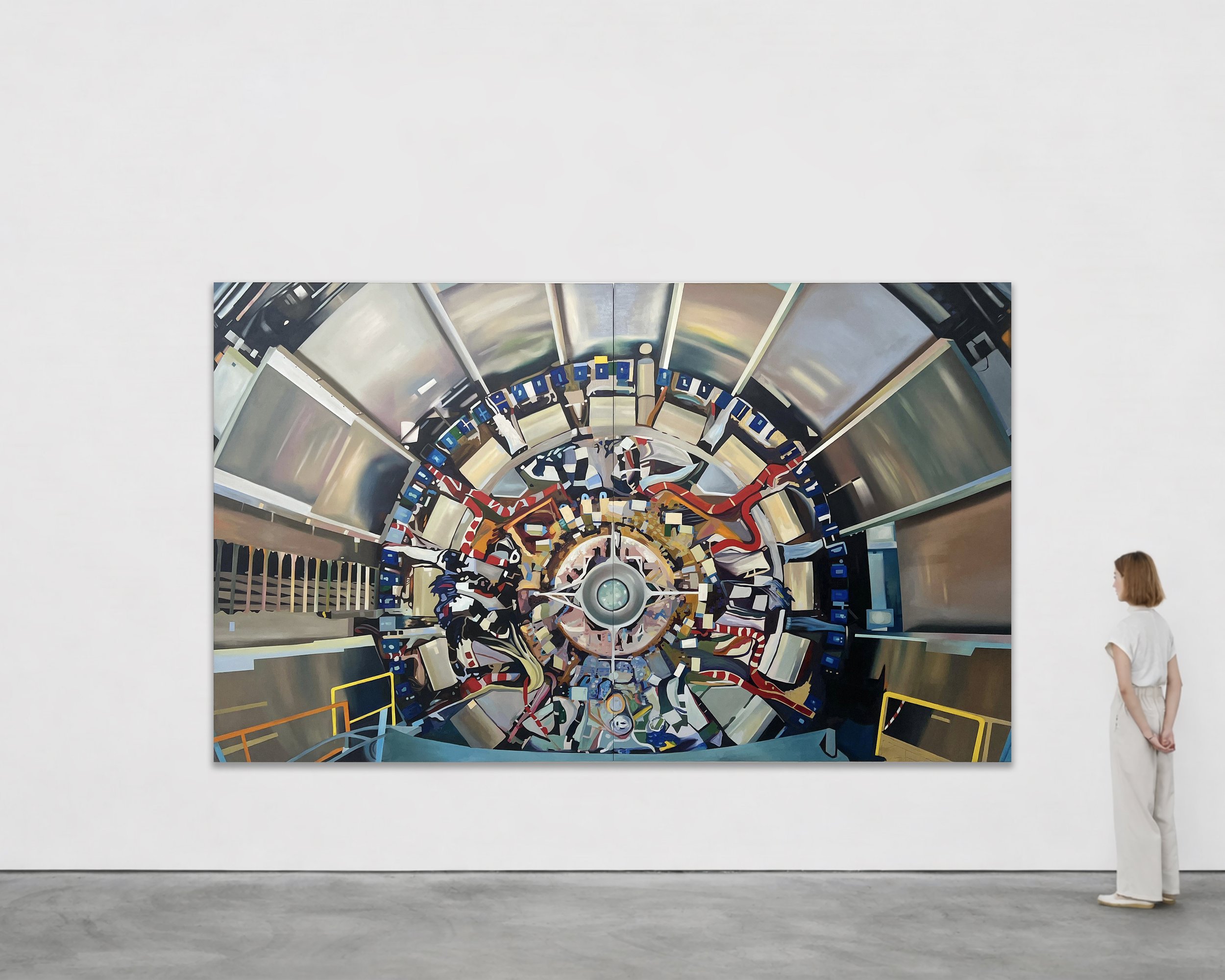
Tan Mu's Large Hadron Collider (2025) confronts this paradox head on: the largest machine ever built, dedicated to the smallest things in existence. The painting measures 180 x 300 cm, nearly two meters tall and three meters wide, a scale that mirrors the ambition of its subject. This is not the first time Tan Mu has painted the LHC. A 2023 version at 122 x 91 cm approached the same machine from a more intimate distance. The 2025 painting expands not just in dimension but in conceptual reach. Where the earlier work treated the collider as an apparatus, the new one treats it as architecture, as collective endeavor, as something closer to a cathedral whose congregants are thousands of scientists and whose liturgy is proton collision data.
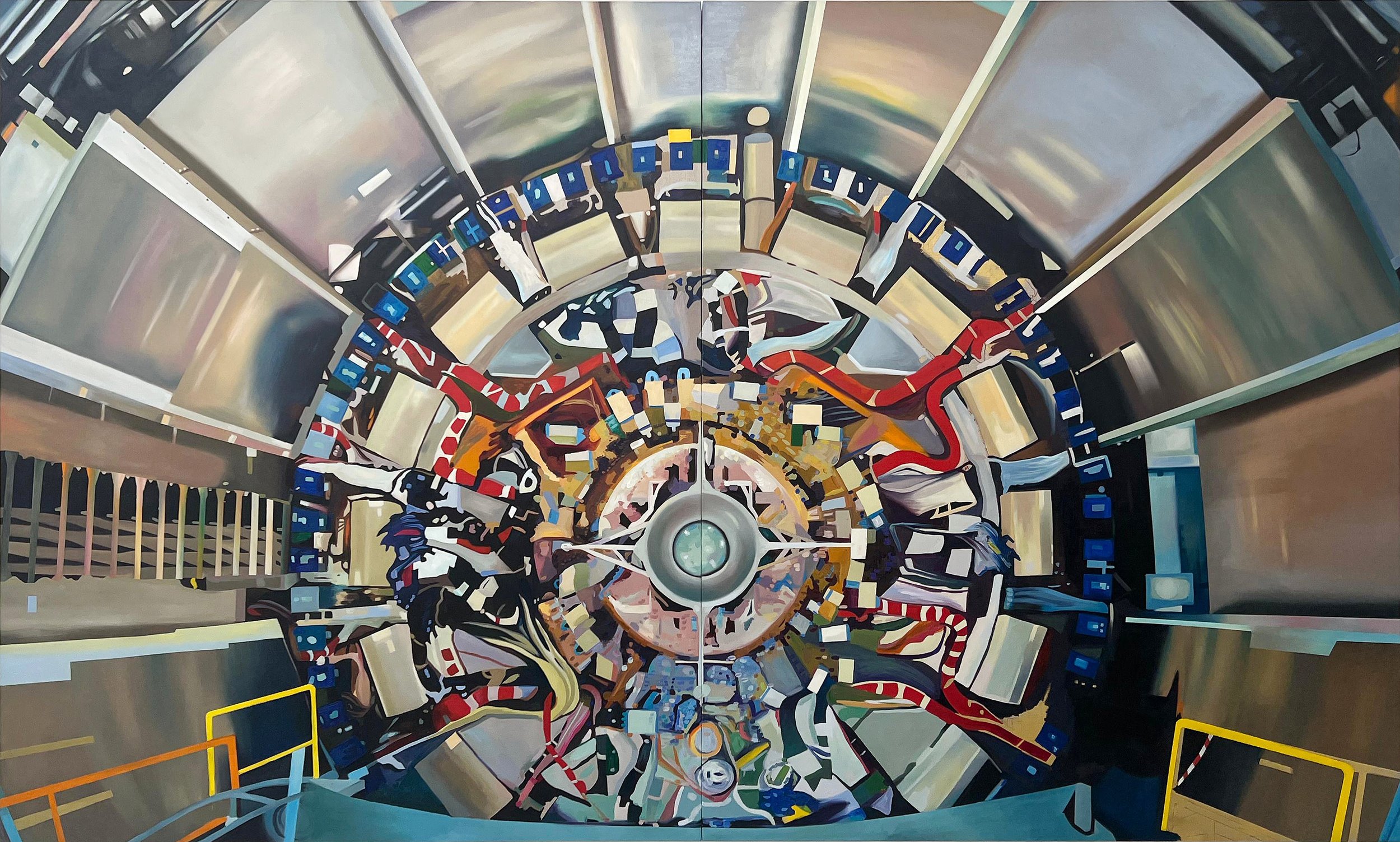
The painting's surface operates at two registers that refuse to settle. From across the room, the composition reads as a dense network of intersecting arcs, diagonal traces, and luminous nodes against a deep, nearly black ground. The structure suggests circuitry, or a celestial map, or the cross section of something vast whose full extent exceeds the frame. The lines are not uniform. Some carry the weight of infrastructure, thick and deliberate, while others tremble with the fine agitation of energy released. The color palette is restrained: deep blues, metallic grays, flashes of white and pale gold at the intersection points where the beams would converge. There is no attempt at photographic fidelity. The collider has been translated into a visual language of marks and intervals, and the translation is what the painting is, not a step on the way to something more accurate.
At arm's length, the surface reveals its physical intelligence. The linen shows through in places, its weave creating a faint grid that the painted lines both follow and resist. The connection points, as Tan Mu has described in discussing her Signal series, are built up with thick, wax-heavy oil paint, raised above the surface like soldered joints on a circuit board. These tactile nodes catch raking light and cast tiny shadows, making the painting shift as the viewer moves. The broader strokes lay down the architecture of the tunnel, the detectors, the magnetic guiding fields. The finer lines record something else: the paths of particles that existed for a millionth of a second before decaying into cascades of daughter particles, each decay an event so brief that only its trace, recorded by layers of detectors, confirms it happened at all. The painting holds both scales simultaneously: the tunnel you could walk through and the collision you could never see, the machine that weighs as much as a naval destroyer and the Higgs boson that lasted less than a zeptosecond.
Giovanni Battista Piranesi spent the last decade of his life etching imaginary prisons. The Carceri d'invenzione, first published around 1750 and reworked in a darker, more vertiginous edition in 1761, depict vaulted interiors of impossible scale: staircases that lead to platforms with no railings, arches that open onto further arches, wooden ramps and chains and pulleys descending into depths that the viewer's eye cannot plumb. The etchings contain almost no figures. When a tiny human appears, dwarfed by the architecture around them, the effect is not comfort but the opposite: the space amplifies isolation rather than relieving it. Piranesi's prisons are not dungeons in any penal sense. They are exercises in architectural sublime, structures that exceed comprehension and make the viewer's own body feel insufficient as a measuring instrument.
Tan Mu's collider painting shares this quality. The 180 x 300 cm canvas creates an architectural interior of its own, a space the viewer enters rather than merely observes. The dark ground functions like Piranesi's ink washes: it establishes depth without specifying what that depth contains. The lines that traverse the surface are not confined to a single plane. Some appear close, others recede, and the intervals between them suggest passages and chambers extending far beyond the rectangle of the canvas. Where Piranesi used etching needle and acid to carve space into copper, Tan Mu uses oil paint and linen to carve a subsurface world. Both artists build environments that the eye navigates without ever reaching a horizon. Both make the absence of a human figure into a structural decision. The collider operates without spectators. The particles collide in darkness. The painting registers the traces of something that happened when no one was looking.
But Piranesi's prisons were fantasies. The LHC is real. It operates under farmland and vineyards, beneath villages where people have no reason to know what accelerates beneath their feet. This is where the Piranesian comparison bends and something else enters the frame. The LHC is not a singular vision imposed on stone. It is the product of coordinated labor across nations, languages, and decades. Tan Mu has described it as a form of collective effort, and the painting reflects this. The lines do not radiate from a single center. They converge from multiple directions, each trace the record of a separate trajectory, a separate team's contribution to the whole. The painting's compositional logic is not hierarchical but distributed, mirroring the way the collider was built: by consortiums, committees, working groups, each responsible for a segment of the ring, each contributing to an apparatus whose full operation no single individual comprehends.
The Large Hadron Collider runs 27 kilometers of superconducting magnets through a tunnel that was originally excavated for an earlier machine, the Large Electron-Positron collider, which operated from 1989 to 2000. The LEP was decommissioned, its accelerator dismantled, and the tunnel repurposed. The LHC inherited this circular cavity and made it deeper, colder, more powerful. Four main detectors, each the size of a cathedral, sit at points around the ring where the beams cross: ATLAS, CMS, ALICE, and LHCb. Each detector is a multilayered instrument, like an onion, with concentric shells of tracking chambers, calorimeters, and muon detectors. When two protons collide, the resulting spray of particles passes through these layers, leaving traces that are reconstructed by algorithms into three-dimensional event displays. A single collision inside ATLAS produces roughly one megabyte of raw data. The LHC generates around one billion collisions per second. The trigger system, a hierarchy of custom hardware and software, reduces this torrent to roughly one thousand events per second that are saved for analysis. The rest are discarded forever. This means that for every collision the physicists examine, approximately one million others vanished without record, their data deemed insufficiently interesting by an automated system making that decision in microseconds. The collider thus operates on a principle of radical selectivity: it sees by discarding almost everything it sees. The Higgs boson, confirmed on July 4, 2012, was identified not by direct observation but by statistical excess: a bump in a graph that persisted across enough collisions to pass the threshold of discovery. This is how the smallest things in nature announce themselves: not through appearance but through pattern, not through direct sight but through inference.
Tan Mu has spoken about the collider in terms that connect it to her broader practice. She describes it as "a modern altar," a phrase that links the apparatus to something older than particle physics. The altar is where humans gather to confront what exceeds their grasp. The word "altar" does not imply worship of the machine itself but recognition that the machine serves a function once reserved for sacred spaces: the mediation between visible and invisible, between the known and the barely detectable. The paintings that sit alongside Large Hadron Collider in Tan Mu's practice, works like Powehi (the first imaged black hole), Moldavite (a meteorite-formed tektite), and Sagittarius A* (the Milky Way's central black hole), share this orientation toward objects and phenomena that sit at the edge of human perceptual capacity. Each depicts something that cannot be seen with the unaided eye and can only be known through instruments, data, and collective interpretation.
Saul Appelbaum, writing about the Signal series in 2025, introduced the concept of "arbitration" to describe what happens when data passes through multiple notations, forms, and processes before becoming visible. "What matters is not a direct alignment between system and representation," he argued, "but the act of arbitration, the human effort to make sense of a signal as it passes through multiple notations, forms, materials, processes, and consciousnesses." The LHC extends this principle beyond the canvas and into the apparatus itself. The collider does not show particles. It shows traces of traces. The detectors show energy deposits left by particles that decayed before reaching the outermost layer. The algorithms reconstruct those deposits into event displays that no human ever witnessed in real time. The painting, then, is not a representation of the collider as it looks. It is an arbitration of an arbitration: Tan Mu's hand translating a system of translations into a single visual field where machine traces and painterly marks occupy the same surface.
The scale of the 2025 canvas, 180 x 300 cm, is not incidental. It registers a decision about how the viewer's body relates to the subject. At this size, the painting does not hang on the wall like a window. It functions more like a wall panel, a section of the environment that the viewer must physically navigate. You cannot take it in from a single standing point. To see the upper corners, you step back. To see the texture of the connection points, you step forward. To follow a line from one edge to another, your eye travels a distance proportional to the tunnel's own circumference. The painting makes the viewer's body a measuring instrument, just as the detector makes the collider's collisions legible. This is not metaphor. It is structure. The painting enacts, at the scale of a room, the same relationship between viewer and subject that the collider enacts between instrument and event: a mediated encounter with something that exceeds direct perception.
The painting's dark ground is not empty space. It is the color of the tunnel interior, the color of the rock and concrete that encase the accelerator, and the color of a screen before data appears. Against this ground, the fine lines glow. They are luminous without being bright, metallic without being cold. They carry the quality of something that has been coaxed into visibility rather than found that way. The thicker marks at the convergence points, those raised solder-joint nodes, pulse with a different kind of presence: tactile, emphatic, the places where the system produces something detectable. Between the nodes, the lines are tentative, searching, as if the path between collisions were not a straight beam but a drawn line feeling its way across a dark surface. This tension between the precise and the exploratory, between the infrastructural and the particulate, between the tunnel you could walk through and the collision you could never see, is where the painting lives.
Tan Mu's years of observing the night sky through telescopes at Alfred University's Stull Observatory gave her direct experience of an earlier form of collective seeing: the coordinated observation of celestial events that no single pair of eyes could resolve. A telescope, like a particle detector, is an instrument that makes the invisible legible. The observatory's six domes and fiber-fed spectrograph, housed on a rural hilltop in western New York, were built and maintained by teams of astronomers who understood that meaningful observation required collaboration, calibration, and patience. What you saw through the eyepiece was not the moon or the star. It was light that had traveled for minutes or millennia, filtered through glass and atmosphere and instrument, arriving as data. The experience of standing in a cold dome at two in the morning, waiting for the moment when the object you were tracking rose above the treeline, taught something that the LHC teaches on a different scale: that seeing is always mediated, and that the mediation is not an obstacle but the condition of the knowledge itself.
Consider the contrast with Piranesi one final time. The Carceri are empty. No one works there. The stairs lead nowhere because no one needs to climb them. The spaces are vast because the etching's logic demands vastness, not because anyone built them for a purpose. Tan Mu's collider, by contrast, is full. It is full of labor, full of intention, full of the accumulated decisions of thousands of minds across decades. The lines in the painting are not decorative fantasies. They are the traces of a system designed to produce knowledge, a system that could only be built by a species that decided, collectively, to spend thirteen billion dollars and twenty-seven kilometers of tunnel to find out what holds mass together. The painting does not celebrate this decision. It registers it. The lines on the dark ground are the record of a choice to build, to coordinate, to look.
The collider is, as Tan Mu has said, a form of collective labor. But the word "labor" can sound noble in a way that distracts from what is strange about the LHC. What is strange is not that humans worked together. What is strange is that they built a machine that operates at scales removed from any direct human experience: temperatures colder than the cosmic microwave background, energies that recreate the first trillionth of a second after the Big Bang, particles that exist for less time than it takes light to cross the width of a proton. The machine reaches for the beginning of time and it does so by operating at scales where time itself becomes a different substance. And it does this not through a single act of genius but through the accumulated decisions of funding agencies, steering committees, graduate students debugging trigger algorithms at three in the morning, cryogenic engineers learning to circulate superfluid helium through twenty-seven kilometers of pipe without a single leak. The labor is real, but it is not romantic. It is administrative, iterative, often tedious. The painting does not depict this labor. No figure bends over a console. No hand adjusts a magnet. But the painting's structure, its network of converging lines built from multiple directions toward shared nodes of maximum intensity, enacts the logic of coordinated effort. Each line arrives at a crossing point where the system produces something detectable, just as each team's contribution converges at a detector where the invisible briefly becomes legible. The painting, at 180 x 300 cm, reaches for a different kind of beginning: the moment when a surface becomes a space, when marks become architecture, when the traces of something invisible arrange themselves into something a viewer can walk toward and stand before and feel the scale of their own not-knowing. The dark ground holds. The lines traverse it. The nodes pulse. The viewer stands in front of all of it, measuring the distance between what can be seen and what can only be inferred, and finds that the distance is where the painting breathes.