The Terrain That Looked Like Home: Tan Mu's Mars 02 and the Desert That Came From Another Planet
It takes between four and twenty-four minutes for a signal to travel from Mars to Earth, depending on orbital position. The images that NASA's Curiosity rover transmits arrive as data packets that are assembled, corrected, and color-calibrated by teams of scientists before being released to the public. The sky in the raw files is not the butterscotch haze that appears in the published versions. Curiosity's cameras see in a different spectrum. What we recognize as the Martian landscape, with its rust-colored dust and pale sky, is the product of deliberate interpretation: algorithms that adjust white balance, composites that stitch multiple frames into a single panorama, and color targets mounted on the rover's body that give Earthbound processors a reference point. The landscape we think we see on Mars has already been translated before we see it. It has passed through the machine and through the human hands that operate the machine. It is a landscape twice mediated.
Each of Curiosity's Mastcam frames captures a scene roughly the size of what a human eye would see if it were standing where the rover stands, but the resolution, the color range, and the spectral bands exceed what human vision can process. The rover does not see as we see. It records data about light reflecting off surfaces in wavelengths we cannot perceive, and this data must be converted into something that approximates human vision. This conversion is not neutral. Every choice about white balance, about which spectral bands to map to which color channels, about how to handle the dust that scatters light in every direction on a planet with no rain to clean the atmosphere, involves a decision. The published images of the Martian surface are the most accurate approximations available, but they are approximations nonetheless. They are not what Mars looks like. They are what Mars looks like when a particular set of instruments and a particular set of algorithms have finished their work.
Tan Mu's Mars 02 (2025) adds a third translation. Oil on linen, 28 x 36 cm (11 x 14 in), the painting takes a fragment of Martian terrain, itself already a product of rover optics and algorithmic correction, and renders it in the material language of brush and pigment. The format is deliberate. This is the same compact dimension she has used for Trinity Testing, Off, Vision, and The Splash of a Drop, works that capture moments of intensity or transformation. The small scale creates concentration. A planet one hundred and forty million miles away, photographed by an autonomous machine, corrected by algorithms, published by a space agency, and then painted by hand on a surface smaller than a laptop screen. Each step in the chain reduces the distance between viewer and subject, and each step also reconstitutes the subject as something slightly different from what the previous step produced. The painting does not restore an original view. There is no original view to restore. There is only the chain of mediations, and the painting makes that chain visible by adding its own link.
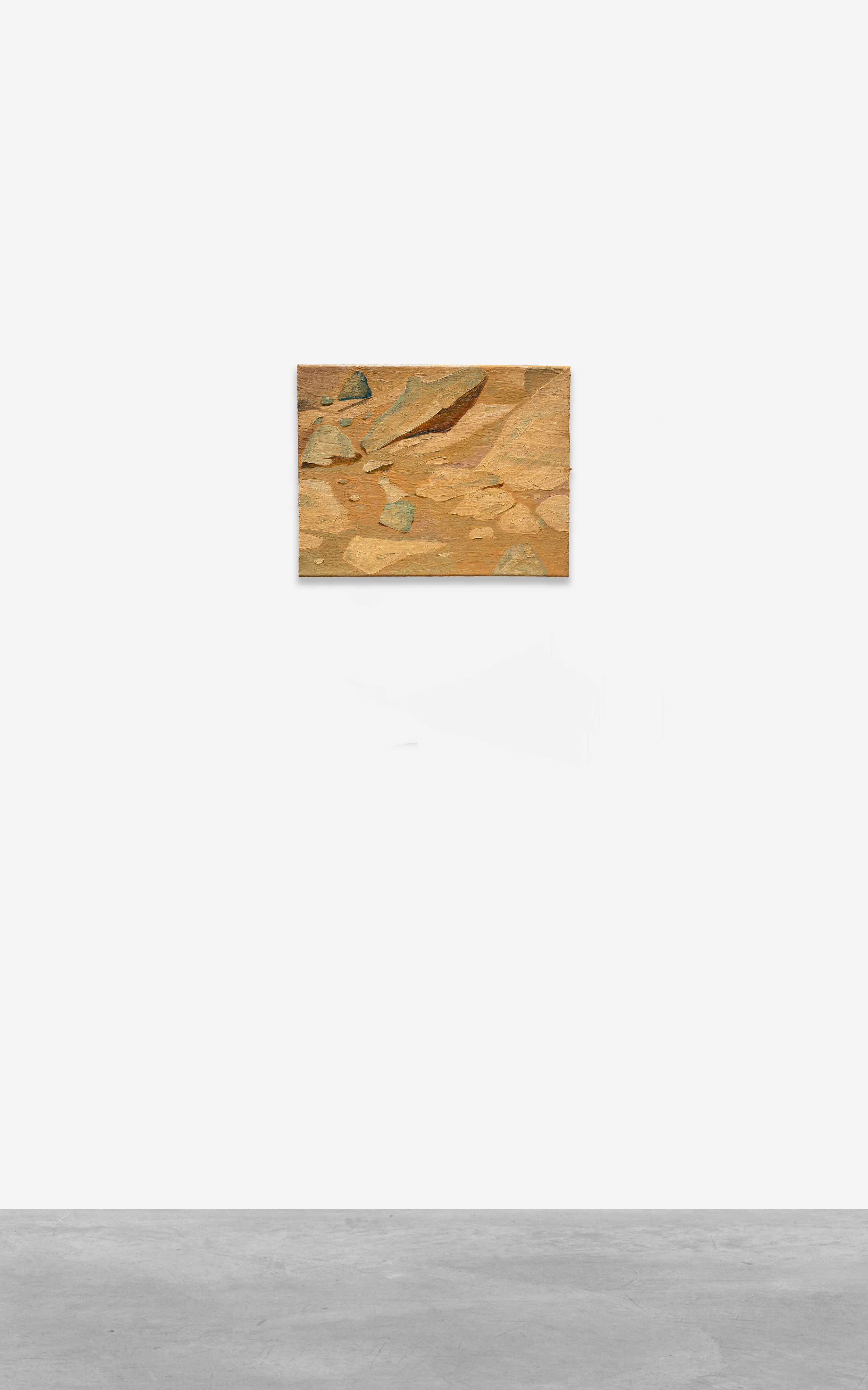
The surface of Mars 02 is built from thin, closely observed layers. The ground is a warm ochre, not uniform but shifting between burnt sienna and a paler dust tone that reads as sun-bleached rock. Against this ground, darker marks register as shadows cast by rocks and ridges, their edges softened just enough to suggest the atmospheric haze that diffuses light on a planet with a thinner atmosphere than Earth's. The brushwork in these shadow zones is economical: a few loaded strokes, some dragged and some placed, each one establishing a relationship between surface feature and the light that defines it. The linen weave is visible in places where the paint film is thinnest, giving the surface a texture that echoes the granularity of the Martian regolith without attempting to replicate it literally.
In the upper register, the sky is handled differently. Where the terrain is built from accumulated marks, the sky is washed: broader, thinner passages of pale gold and white that let the linen breathe through. This is not the blue sky of an Earth landscape, nor the black sky of astronomical photographs. It is the peculiar butterscotch of Mars as Curiosity's Mastcam records it, a sky whose color tells you that the atmosphere scattering the sunlight is made of iron oxide dust, not water vapor. Tan Mu has captured this quality without over-describing it. The sky reads as atmosphere rather than emptiness, a thin shell of particulate light suspended above the terrain like a membrane. The transition from ground to sky happens without a hard horizon. The top of the terrain dissolves into the bottom of the atmosphere, and the painting refuses to specify where one ends and the other begins.
The connection points, those raised nodes of wax-heavy paint that Tan Mu builds up at intervals across the surface, are present here but subtler than in the Signal series. Where the submarine cable paintings use raised marks to register the physical presence of data infrastructure, the Mars paintings deploy similar marks more sparingly: at the edge of a rock face, at the crest of a ridge, at the point where shadow meets illuminated ground. They anchor the composition, pulling the viewer's eye toward the moments where the terrain becomes legible, where a slope becomes a slope rather than a smear of pigment. These marks also function as a reminder of the painting's materiality. In a work about a landscape seen through a machine, the raised paint insists on the presence of the hand.
In 1818, Caspar David Friedrich painted a figure standing on a rocky outcrop, his back to the viewer, facing a vast landscape of fog-shrouded mountains. Wanderer above the Sea of Fog has become one of the most reproduced images in Western art, and its iconography is so familiar that it is easy to miss what is radical about it. The wanderer does not gaze into the distance in contemplation. He occupies the landscape as a vertical interruption. His dark coat and wide-brimmed hat cut a sharp line against the pale fog, and his body becomes the axis around which the entire composition organizes itself. Without him, the painting would dissolve into formless mist. He is not observing the landscape. He is making it legible.
The Curiosity rover serves a structurally similar function in Tan Mu's Mars series, though it is never depicted directly. Mars 02 does not show the machine. It shows what the machine saw. The rover's absence from the canvas is the condition that makes the painting possible. Without the rover, there is no image of this terrain. Without the rover's camera, there is no composition of rock, dust, and butterscotch sky. The landscape exists for human perception only because a machine with seventeen cameras was sent to traverse it, photograph it, and transmit those photographs across interplanetary space. In Friedrich's painting, the wanderer's body stabilizes the composition and gives the viewer a surrogate presence in the landscape. In Mars 02, the machine's absence performs a parallel function: it stabilizes the terrain as something seen, something transmitted, something that has already been selected and framed before the painter's brush ever touched linen. The painting is a landscape without a wanderer, but it is a landscape that exists only because a wanderer was there.
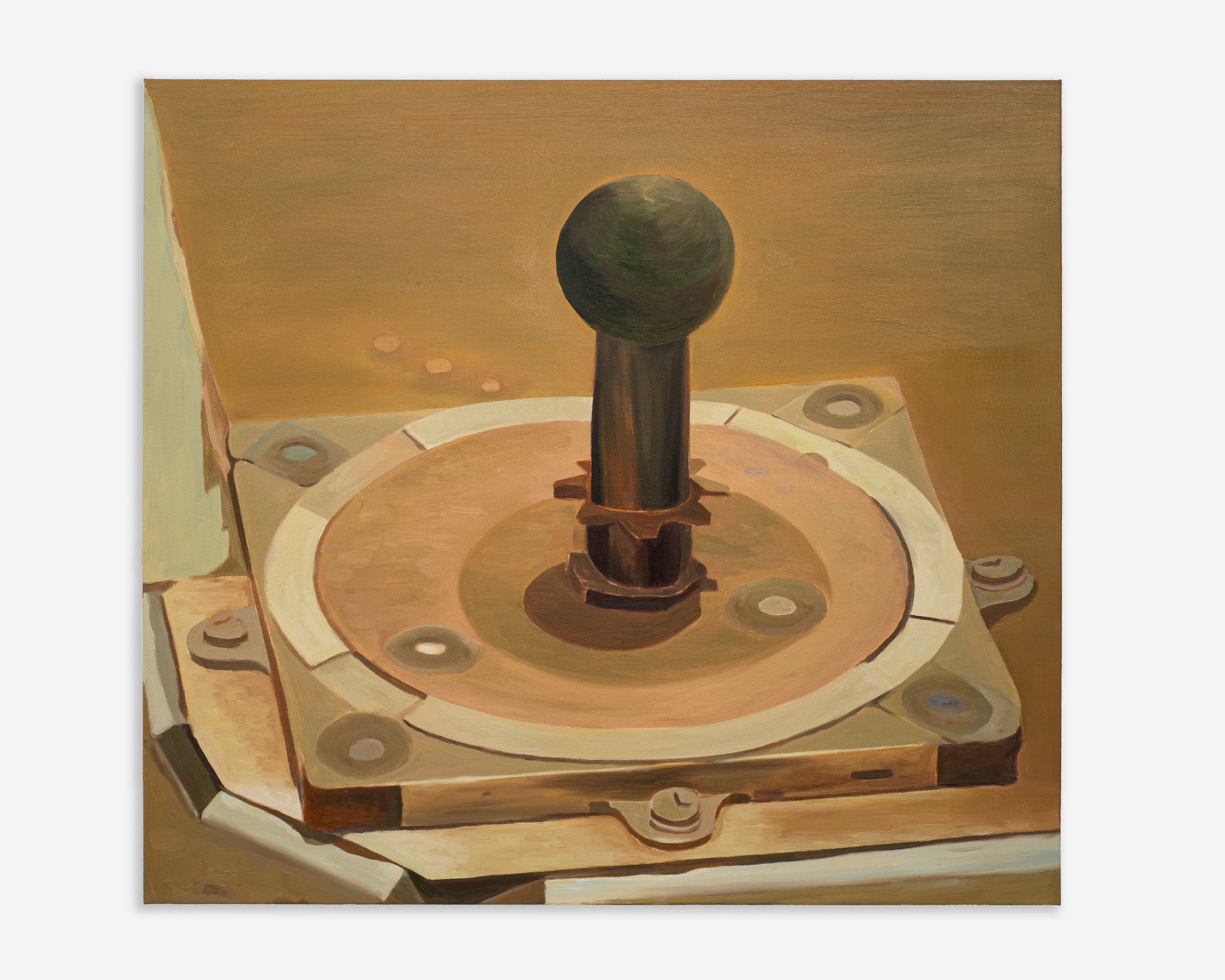
The Curiosity rover, formally the Mars Science Laboratory, landed on the floor of Gale Crater on August 6, 2012. It was designed for a two-year mission. Thirteen years later, it is still operating, having driven more than thirty kilometers across the crater floor and ascended the lower slopes of Mount Sharp, the layered mountain at the crater's center. Its Mastcam system, built by Malin Space Science Systems in San Diego, captures images in multiple spectral bands, including wavelengths invisible to the human eye. The color images released to the public are composites that approximate what a human eye would see under Martian lighting conditions, but this approximation requires judgment calls about white balance and color calibration that are themselves interpretations. The rover does not see Mars. It records data about light reflecting off surfaces. The conversion of that data into something that looks like a landscape is a choice, and Tan Mu's painting registers this choice by adding another one.
The terrain that Curiosity has been traversing is, by any geological measure, ancient. The rocks in Gale Crater are between three and four billion years old. They were laid down in lake beds and river channels when Mars still had liquid water on its surface. The layered sediments that Curiosity reads as a geological timeline record a period when Mars was warmer, wetter, and more like Earth than it is now. The resemblance that Tan Mu noted between the Martian surface and terrestrial deserts is not coincidence. It is geological kinship. The same processes that shaped the Gobi, the Sahara, and the Atacama, wind erosion, sediment deposition, the slow redistribution of particulate matter by atmospheric forces, operated on Mars during its wet period and continued operating after the water disappeared. The landscape looks familiar because the physics that produced it are the same physics that produced the deserts Tan Mu has visited in Mongolia and elsewhere. Curiosity has drilled into these ancient lakebeds and found clay minerals, organic molecules, and chemical signatures consistent with habitable conditions. The rover's findings suggest that Gale Crater held water for millions of years, long enough for life to have emerged if the chemistry was favorable. The rocks that Tan Mu translates into ochre and sienna on linen are, in other words, not merely the remains of a dead world. They are the remains of a world that once had conditions not so different from the ones that produced the landscapes she has walked through on Earth. The painting holds this temporal ambiguity without declaring it. The terrain could be yesterday or three billion years ago. The dust could be settling now or it could have been settling for eons. The surface of the canvas does not distinguish between geological time and human time because the rover does not distinguish between them either. It photographs what is in front of its lenses, and what is in front of its lenses is a landscape shaped by processes that operate on scales no human lifespan can measure.
Tan Mu has described the experience of encountering these images with a specific kind of recognition. "When I first studied the images of Mars, I was struck by how familiar they felt," she has said. "The rocks, sand, and slopes reminded me of arid landscapes on Earth, particularly regions like Mongolia. I have visited deserts where the scale, silence, and openness create a powerful contrast with urban life, and the Martian surface carries a similar presence." The word "presence" is significant. She does not say the images looked like deserts she has seen. She says the Martian surface carries a presence similar to what she experienced in those deserts. The distinction is between visual resemblance and bodily recognition, between what the eye registers and what the body knows from having stood in a vast, quiet, open space and felt its weight.
This collapse of distance is what distinguishes Mars 02 from the tradition of astronomical illustration that precedes it. For most of human history, images of other planets were speculative. Chesley Bonestell's paintings of Saturn from the surface of Titan, published in Life magazine in 1944 and later in his 1949 book The Conquest of Space, were imaginative reconstructions based on limited data. They were beautiful and influential, but they depicted places that no instrument had seen. Bonestell painted what scientists hypothesized, and his images shaped public expectation of what other worlds might look like. The Mars that Curiosity transmits is different. It is not speculation. It is data, processed and composited and color-corrected, but it is data that originated from photons bouncing off actual rocks on an actual surface. When Tan Mu paints this landscape, she is not illustrating a hypothesis. She is translating a document, and the document itself is already a translation.
Li Yizhuo, writing about Tan Mu's practice in 2022, identified what she called the "double mediation" that characterizes works derived from technological sources. "The painting does not pretend to offer direct access to its subject," Yizhuo argued. "It acknowledges, from the first brushstroke, that the subject has already passed through an apparatus, and that the painting's relationship to that subject is therefore always indirect." This formulation clarifies what Mars 02 is doing with its modest dimensions and its restrained surface. The painting does not attempt to be big enough to contain a planet. It makes itself small enough to hold a fragment of a view that has already been compressed by optics, algorithms, and transmission. The 28 x 36 cm canvas is not a window onto Mars. It is a record of a chain of transmissions, and its scale insists on that fact.
The specific format that Tan Mu has chosen for the Mars paintings, shared with works depicting a nuclear test, a frozen signal, a droplet in motion, and the surface of another planet, creates an implicit argument about scale and intimacy. These are all subjects that exceed the human body in some dimension: the blast radius of a nuclear weapon, the bandwidth of a transatlantic cable, the trajectory of a falling drop, the distance to another planet. By rendering them at a size that a viewer can hold in two hands, Tan Mu refuses the sublime enlargement that most space imagery invites. There is no attempt to overwhelm. The painting asks to be looked at closely, the way you might examine a photograph held at arm's length, and this closeness produces a different kind of encounter than the panoramic awe that NASA's own composite images are designed to generate.
The Martian terrain in Mars 02 is not empty. It is occupied by rocks, ridges, and the suggestion of a slope ascending toward the right. But it is uninhabited. No human has stood where the rover's camera pointed. No footstep has compressed that regolith. The absence is structural. Landscape painting has always implied a viewer, someone standing where the painter stood. Even Friedrich's wanderer, though his face is hidden, confirms that a human body can occupy this place. The Mars paintings remove that certainty. The viewer who stands before Mars 02 in a gallery is occupying a position that no human body can occupy on Mars. The painting makes this displacement legible. The landscape is there. You are here. The distance between those positions is the subject of the work.
Tan Mu has spoken about this collapse of distance with precision. "This resemblance fascinates me," she said of the Martian terrain's similarity to terrestrial deserts. "It collapses the distance between Earth and Mars, between the known and the unknown." The verb matters. The distance is collapsed, not eliminated. The terrain still belongs to another planet. The rocks still rest on ground that no human has walked. But the visual vocabulary, the arrangement of dust and stone and shadow under a pale sky, is recognizable enough that the body registers it before the mind has time to categorize it as alien. The painting lives in that interval between recognition and classification, the moment when the desert looks like home before you remember that it is one hundred and forty million miles away. The ochre ground and the thin gold sky hold that tension without resolving it. The painting does not ask you to forget the distance. It asks you to feel both things at once: the familiarity and the absolute remove, the desert you could walk through and the desert no one has walked through. That double awareness, sustained across a surface smaller than a laptop screen, is where Mars 02 finds its footing.