The Surface That Erases Itself: Tan Mu's 4K and the Green Screen Between Recording and Recorded
Chroma key compositing works by making a specific color disappear. In film and television production since the 1940s, a uniformly lit green or blue background is photographed, then digitally subtracted from the image and replaced with another image entirely. The weather forecaster standing in front of a green wall appears on screen as though standing in front of a satellite map. The actor dangling from wires in front of a green screen flies through a digital sky. The green itself has no content. It is chosen precisely because it carries no information, because it can be made to vanish without leaving a trace. The green screen is the most visible surface in the production studio and the most invisible in the final image. It exists to be erased. It is a technology that functions by making itself disappear.
Tan Mu's 4K (2022) arrests this technology mid-process. Oil on linen, 41 x 51 cm (16 x 20 in), the painting presents a chroma-key screen frozen in the moment of recording. The viewer is positioned within the camera's perspective, looking at a field of saturated green that fills nearly the entire canvas. In the upper left corner, a red dot and the letters "4K" indicate that the camera is actively capturing, that what we see is being recorded at the highest available resolution. The red dot carries the implicit threat of surveillance: someone is watching, and the apparatus of watching is itself on display. The painting holds the green screen in the state before it has been composited, before it has been replaced by another image. It shows the technology at its most raw, the surface that exists to disappear, made permanent in oil paint.
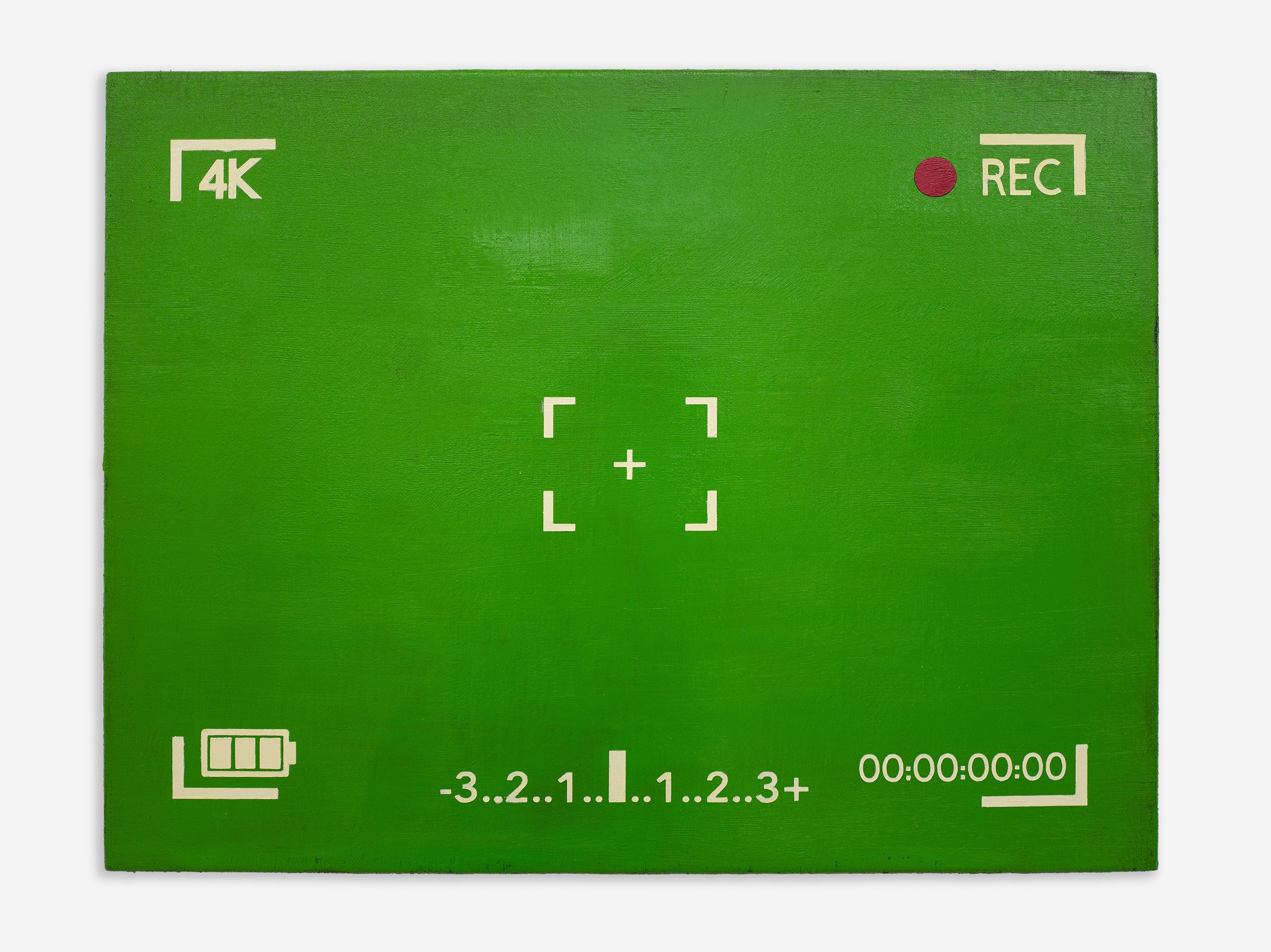
The surface of 4K is built through a process that Tan Mu has described in relation to her screen-based works, particularly Play (2022), which shares its visual vocabulary. She begins with a dark ground and applies multiple layers of green oil paint, building density through successive passes. The final effect is achieved through horizontal brushstrokes swept across the canvas, creating wave-like bands that reference the scan lines of cathode-ray tube displays and the refresh rates of early video technology. These bands are not uniform. They vary in width, opacity, and intensity, some thin enough that the dark ground shows through, others thick enough to read as solid fields of color. The result is a surface that oscillates between the material and the immaterial: at a distance, the green appears as a flat, electronic field; up close, it reveals itself as a layered construction of oil on linen, each band the trace of a physical gesture across the surface.
The color itself is worth pausing over. This is not the green of grass, leaves, or any natural surface. It is the specific, synthetic green of chroma-key technology, a color engineered for maximum contrast against human skin tones, chosen because it appears so rarely in natural environments and clothing that it can be isolated and removed with minimal collateral damage to the rest of the image. The green in 4K is not decorative. It is functional. It does what chroma-key green does: it signals its own replaceability. And yet, by fixing this green in oil paint, by making it the subject of the painting rather than the invisible substrate of compositing, Tan Mu reverses its function. The green that was designed to disappear becomes the thing that remains. The surface that was built to be erased becomes the object of sustained attention.
The red recording indicator in the upper left corner changes the painting's terms. Without it, the canvas would read as an abstract field of green, a monochrome with internal variation. The dot and the "4K" label anchor the image to a specific technology and a specific moment within that technology's operation. They tell the viewer that what they are looking at is not simply green paint on linen but a representation of a screen in the process of capturing an image. The red dot also introduces the question of who is being recorded. In Tan Mu's own description, the meaning of the red dot "depends on its position within the visual field. When it appears inside the frame, the viewer may feel as though they are being observed rather than simply observing." The painting turns the camera back on the viewer. The screen that was designed to capture the world now captures the person looking at it.
In 1968, Vera Molnár began using a computer to generate drawings composed of horizontal lines. Working with a program she wrote herself, Molnár instructed the machine to draw lines across a grid, introducing controlled variations in spacing, angle, and thickness. The resulting works, which she called Des Ordres (Orders), appear at first glance to be orderly arrangements of parallel lines. On closer inspection, small perturbations emerge: a line slightly thicker than its neighbors, a gap marginally wider than the one above it, a systematic order that has been subtly disturbed by the introduction of a variable the artist controls. Molnár described these works as occupying the space between order and disorder, between the predictable output of a machine and the deliberate disruption introduced by the artist's hand.
The connection between Molnár's Des Ordres and Tan Mu's 4K is not one of style but of structure. Both artists use horizontal lines to reference the technology of the screen. Both introduce controlled variation into what appears at first to be a uniform field. Both position the viewer in front of a surface that is simultaneously a record of a process and a representation of a technology. The difference is one of emphasis. Molnár's works foreground the algorithm: the lines are the output of a program, and the viewer is invited to notice where the program's logic has been interrupted. Tan Mu's work foregrounds the screen itself: the lines are not the product of an algorithm but a handmade simulation of what an algorithm produces, a painterly reconstruction of the scan line that is itself a product of electronic engineering. Where Molnár uses the computer to generate the image, Tan Mu uses painting to reconstruct the visual language that the computer has made ubiquitous. The horizontal bands in 4K are not algorithmic output. They are brushstrokes that mimic algorithmic output, and the gap between what they are and what they reference is where the painting operates.
Molnár began her computational practice at a moment when the relationship between the artist's hand and the machine's output was still an open question. Working on a mainframe computer at the Université de Paris in the late 1960s, she wrote programs in FORTRAN that generated drawings via a plotter, a mechanical arm that moved a pen across paper according to coordinates calculated by the program. The plotter's lines were clean, uniform, and indistinguishable from one another in a way that no hand-drawn line could be. Molnár's intervention was to introduce what she called distorsions: small, deliberate departures from the grid that the program would otherwise produce. A line would be slightly displaced, a gap would be marginally wider, a cluster would appear denser than its neighbors. These perturbations were not errors. They were decisions encoded in the program itself, variables that Molnár controlled and adjusted from one series to the next. The resulting drawings hover at the edge of perception: from a distance, they look like ordered systems; up close, they reveal the hand of the programmer choosing where and how to disrupt. This is precisely the perceptual oscillation that 4K produces, though it produces it through opposite means. Where Molnár used the machine to simulate the hand, Tan Mu uses the hand to simulate the machine. The visual result is similar: a surface that reads as systematic from across the room and reveals its humanity at arm's length.
Chroma-key technology, also known as green screen compositing, was first developed in the 1930s for film special effects and refined throughout the following decades for television weather broadcasts, science fiction films, and eventually digital video production. The principle is straightforward: a camera records a subject against a uniformly lit colored background, and post-production software identifies all pixels matching that color within a specified tolerance range and replaces them with pixels from a different image. The technology depends on the background being a single, even color with no variation in lighting, texture, or shadow, because any variation makes the compositing algorithm's job harder and increases the risk of artifacts in the final image. The green screen is, in other words, designed to be as smooth and featureless as possible, the opposite of everything a painting traditionally aspires to be. It is a surface without incident, without narrative, without depth. It is pure function, a container waiting to be filled with content that is not yet there.
The history of chroma key reveals something about the relationship between visibility and erasure in image technology. Larry Butler, a special effects technician at RKO Pictures, is credited with using blue screen compositing for the 1940 film The Thief of Bagdad, earning an Academy Award for the technique. The process required optical printing, multiple film exposures, and meticulous alignment of foreground and background elements. When television adopted the technique in the 1950s and 1960s, green replaced blue because the green channel in analog video carries the highest luminance resolution, making cleaner composites possible. By the time digital video became standard in the 1990s and 2000s, chroma key had become so routine that it was invisible: every weather broadcast, every superhero film, every video game stream used it as a matter of course. The green screen became the invisible infrastructure of the image economy, a surface that existed only to vanish. 4K takes this vanishing surface and refuses to let it vanish. The painting holds the green in place, makes it the subject rather than the substrate, and in doing so reverses the entire logic of the technology it references.
Tan Mu's decision to paint this surface is a decision to give it the thing it was designed to lack. The green screen exists to be replaced. The painting makes it irreplaceable. By translating chroma-key green into oil paint, by building it in layers over a dark ground, by sweeping horizontal bands across the linen that reference scan lines while being unmistakably the product of a hand holding a brush, Tan Mu re-introduces materiality into a technology that was engineered to have none. The painting does not depict a green screen in the way a photograph would. It reconstructs the visual experience of looking at one, and in doing so, it makes the viewer aware of the difference between the screen's designed flatness and the painting's achieved depth. The scan lines in 4K are not the same as the scan lines on a cathode-ray monitor. They are thicker, more variable, more obviously the result of a physical gesture. They carry the memory of the hand that made them, and that memory is precisely what the technology they reference was designed to eliminate.

Nick Koenigsknecht, writing about Tan Mu's Signal series in 2025, described the paintings as operating in "the space between the system and the hand," arguing that "what makes these works legible is not their fidelity to the technologies they reference but their deliberate departure from them, the insistence on marks that could only have been made by a body moving across a surface at a particular speed with a particular pressure." Koenigsknecht's observation applies to 4K with particular force, because the green screen is the technology that most aggressively eliminates the hand from the image-making process. A weather broadcast composited in real time shows no trace of the physical surface that made it possible. The green wall in the studio has vanished completely by the time the image reaches the viewer's screen. 4K reverses this vanishing. It restores the hand to the surface that was designed to be handless, and it does so by using the same visual vocabulary, horizontal lines, saturated color, a flat field of uniform hue, that the screen technology itself employs. The painting mimics the screen in order to expose it. It adopts the screen's language in order to reveal what that language conceals.
The red dot in the corner compounds this reversal. In the context of a recording device, the red dot signals that the camera is active, that whatever falls within the frame is being captured and stored. It is a mark of surveillance, a visual indicator that the apparatus is watching. When Tan Mu places this dot inside the painted frame, she creates a feedback loop. The viewer stands in front of a painting that represents a screen that represents a recording device. The device, within the logic of the painting, is recording the viewer. The person looking at the painting is simultaneously the observer of the screen and the subject of its gaze. This is not a metaphor. It is a structural condition of the painting's composition. The red dot, small as it is, transforms the entire field of green from a passive surface into an active one, a surface that watches back.
Tan Mu has described this reversal explicitly. "Green screen technology is typically used to capture and construct images of the external world," she has said. "However, when this technology is painted and placed on canvas, it becomes the object being looked at. The viewer takes on the role of the observer, while the recording mechanism itself becomes visible. This reversal of roles is central to the work. It exposes the subtle power dynamics between seeing and being seen, recording and interpretation." The statement clarifies what the painting enacts: a technology designed to capture the world is itself captured, placed on a surface, and made into the object of a gaze that the technology itself would normally direct outward. The screen that was meant to disappear has been made permanent. The surface that was built to be replaced has become the thing that cannot be replaced. And the viewer who came to look at a painting finds themselves inside the frame of a recording they did not consent to.
The dimensions of 4K, 41 x 51 cm, place it in the same modest scale as several other works in Tan Mu's practice where the subject exceeds the frame. The format creates concentration: a field of green that could be any size is compressed into a surface that can be held at arm's length, and this compression makes the viewer's encounter with the red dot more immediate, more uncomfortable. The painting is small enough that the red dot is not a distant indicator but a presence in the viewer's peripheral vision, a small bright signal that refuses to be ignored. In a gallery setting, the viewer approaches this modest canvas expecting to look at a painting. What they find instead is a screen that looks back, a recording apparatus that has been turned inside out and made permanent in paint.
The 4K resolution standard, after which the painting is named, promises that every detail will be visible, that the image will be sharper than the eye can distinguish. The painting delivers on this promise in an unexpected way: it makes visible the technology that was supposed to remain invisible, and it does so with a clarity that no 4K screen, compositing its green background into something else, would ever permit. In a culture saturated with images that have been composited, filtered, and processed through layers of chroma-key technology, 4K stops the process at its most fundamental layer. It shows the green that disappears in every weather broadcast, every Zoom background, every film set photograph. It makes the invisible substrate of contemporary image production into the object of sustained, uncomfortable attention. The surface that erases itself has been caught in the act of erasure, and the red dot in the corner confirms that the camera is still running.