The City That Breathes: Tan Mu's Horizons 04 and the Grid That Wakes at Night
Tan Mu's maternal grandfather worked at a meteorological station in Yantai, calibrating weather detection equipment and reading the sky for signs of approaching systems. Before he returned to coastal engineering, before he taught her to read bathymetric contour lines and seafloor maps, he taught her to look up. The sky above Shandong province is enormous, a dome that on clear nights holds more visible stars than most children in coastal cities ever see, because the haze of industrial light had not yet reached the parts of the coast where she grew up, or because the winds off the Yellow Sea cleared it often enough that the stars returned with regularity. He pointed out weather patterns, cloud formations, the atmospheric dynamics that would later become the subject of her paintings, and he did so with the precision of a man who understood that the sky is not a backdrop but a system, measurable and readable from the ground, if you know what to look for. Years later, living near Stull Observatory at Alfred University in western New York, she trained a telescope on the moon for the first time and felt the ground shift beneath the scale of her understanding. The moon through a lens was not the moon of childhood. It was a surface, pitted and ancient, close enough that its topography became legible, and the legibility changed everything about what it meant to look upward. These two formative experiences, the meteorologist's sky read from the ground and the astronomer's sky read through glass, converge in the Horizons series, where the vantage has shifted from ground to orbit and the act of looking has become an act of mapping perception itself.
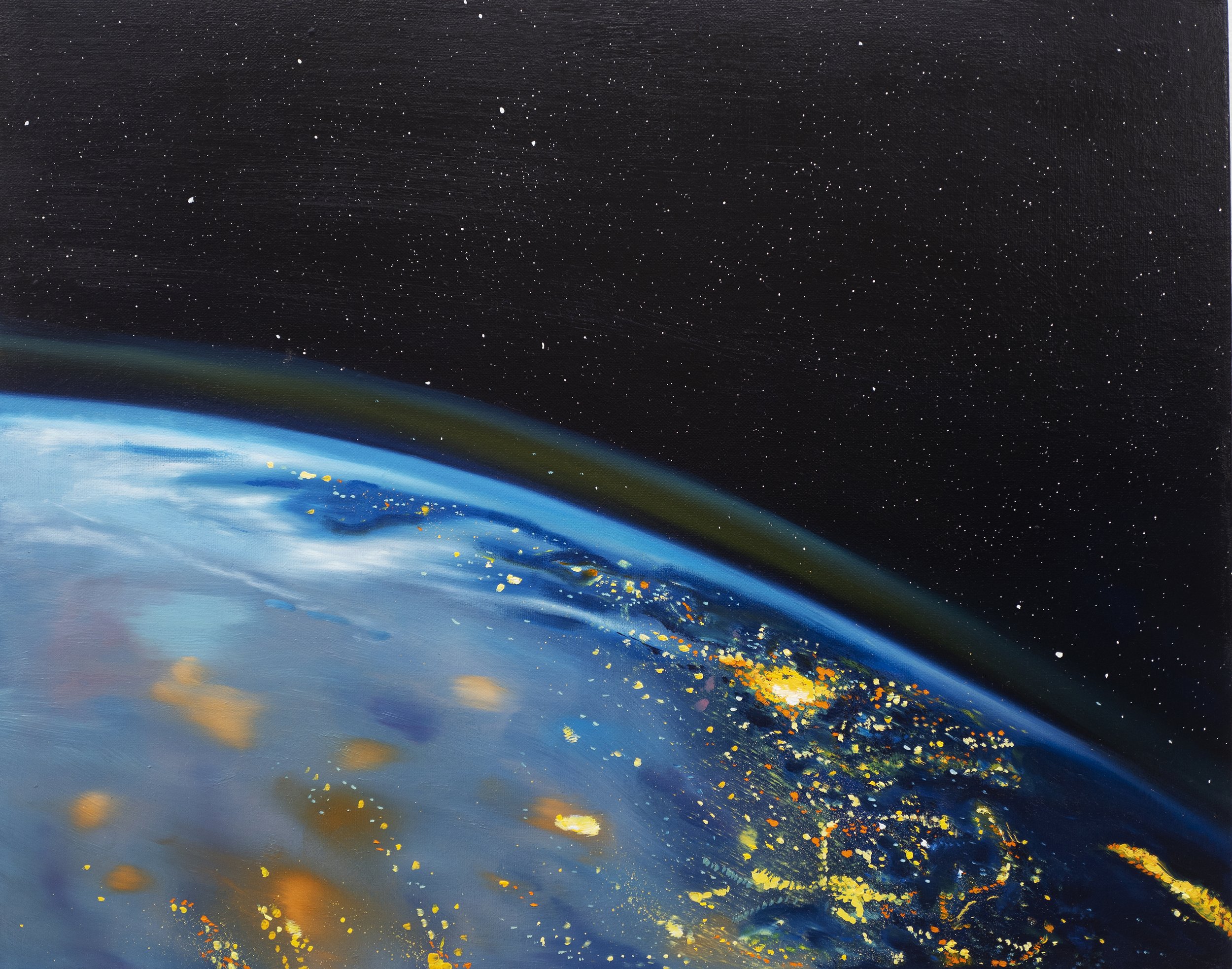
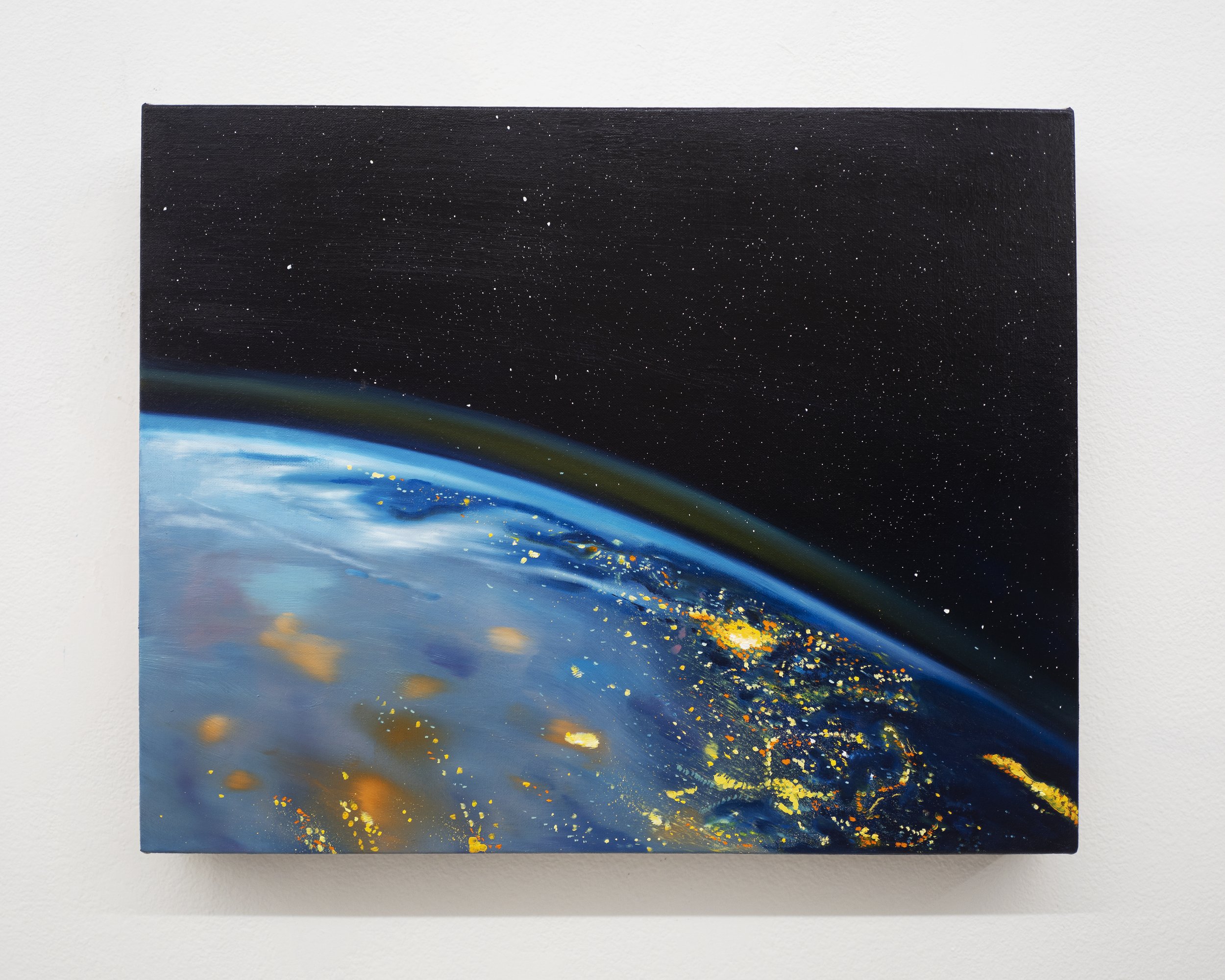
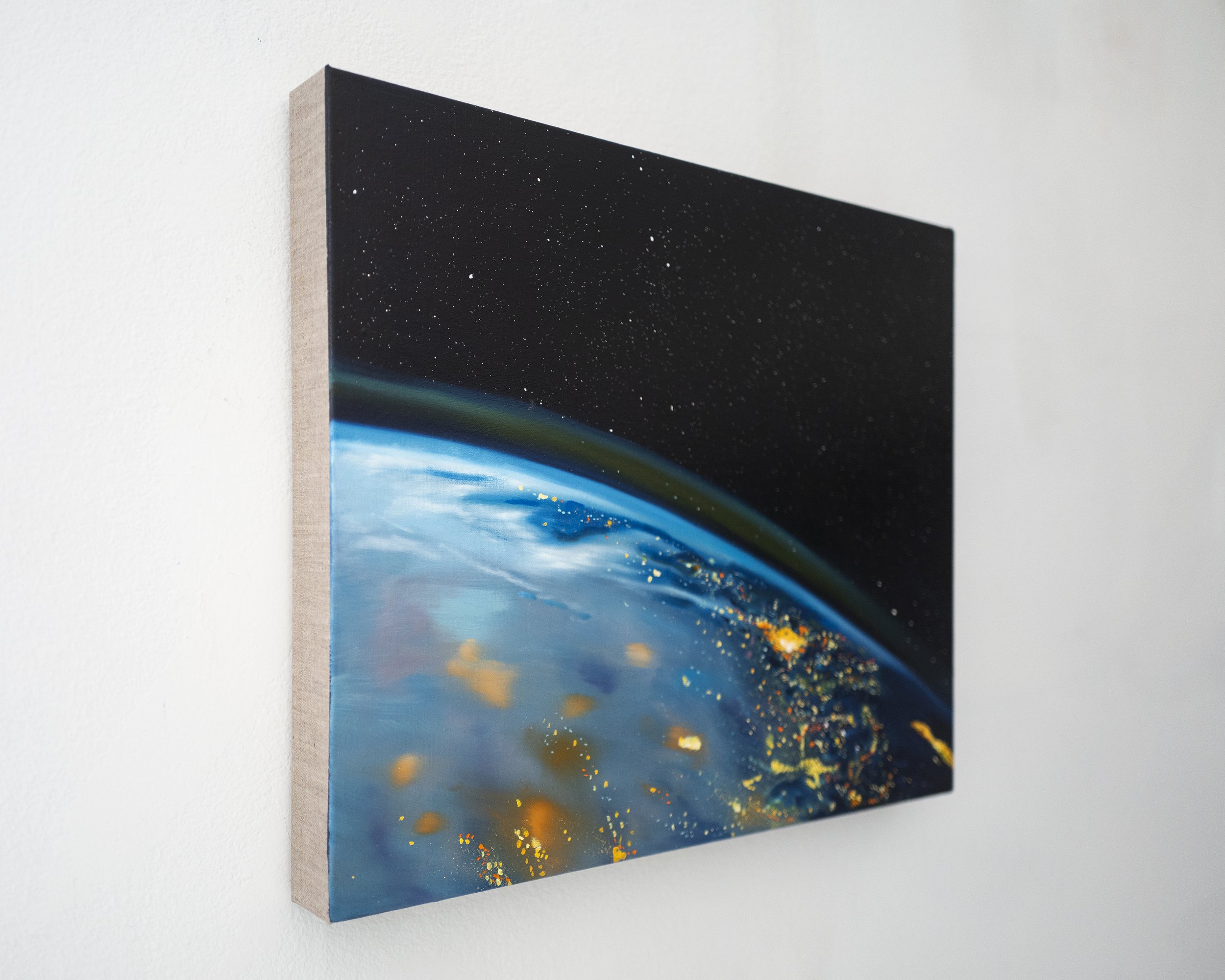
Horizons 04 (2025) is an oil on linen painting, 41 x 51 cm (16 x 20 in), that depicts the Earth from an orbital vantage. The composition is organized around a luminous band of atmosphere that runs roughly across the lower third of the canvas, separating a field of scattered points above from a dark, dense surface below. The atmosphere is not rendered as a thin line but as a gradient zone, a luminous band that graduates from deep Prussian blue at its base through shades of cerulean, teal, and pale gold toward its upper edge, where it dissolves into the darkness of space. This band is the painting's subject and its engine. It is where the light of human habitation meets the light of the sun scattered through gas molecules, and where two entirely different kinds of luminosity, the thermal glow of cities and the refractive glow of an atmosphere, become indistinguishable at the scale the painting adopts.
The upper two-thirds of the canvas presents a star field against near-black ground. The stars are rendered as points of varying size and intensity, from tiny pinpricks barely visible against the dark to larger, brighter marks that carry more pigment and sit slightly raised above the surface. The distribution follows no strict geometric pattern, but it is not random either. The brighter points cluster in ways that suggest the gravitational logic of actual star fields, where larger masses attract nearby material and create local densities within the broader field. Smaller, fainter points fill the spaces between clusters, creating a sense of depth that the flat surface of the linen nominally denies but that the paint's varying thickness partially restores. The linen weave is visible in the darkest passages, a subtle grid of horizontal and vertical threads that catches the light differently than the painted passages and reminds the viewer that the surface they are reading as infinite depth is in fact a piece of fabric stretched over a wooden frame, no larger than a place mat on a dining table.
Below the atmospheric band, the dark ground is broken by clusters of warm light. These are the city lights. They appear as concentrations of gold, amber, and pale yellow, gathered in irregular groupings that follow coastlines and river valleys, just as real cities do when seen from orbit. The clusters range from dense, bright knots, where several points overlap into a single luminous mass, to scattered constellations of smaller points that trail off into darkness. The warm palette of the city lights against the cool palette of the atmosphere creates a chromatic tension that the painting never fully resolves, and this tension is one of its central arguments: the lights of human habitation and the lights of the natural atmosphere are made of fundamentally different stuff, one generated by combustion and electricity, the other by the scattering of solar photons through nitrogen and oxygen molecules, but from the vantage of orbit, they register as the same phenomenon. Light is light. The distinction between natural and artificial collapses at this altitude, and what remains is a pattern of luminosity that the eye groups and organizes according to its own preferences, finding constellations in the city lights below just as readily as it finds them in the stars above.
Piet Mondrian arrived in New York in 1940, a refugee from the war in Europe, and the city rewired his visual system. The grid that had governed his earlier abstractions, the black lines that divided the canvas into compartments of primary color, gave way to something looser, more rhythmic, more responsive to the tempo of the place he had landed. Broadway Boogie Woogie (1942-43), his last finished painting, replaces the black lines with pulsing bands of yellow, red, and blue that intersect and interrupt each other along the canvas's orthogonal axes. The title tells you what the painting is translating: the syncopated rhythm of boogie-woogie piano, the grid of Manhattan's streets, the traffic lights that pulse along Broadway at night. But the painting does not illustrate any of these things. It translates them into a visual language of colored blocks and interrupted lines that produces, in the viewer's eye, an experience of rhythm that is simultaneously visual and temporal. The small blocks of color that replace the intersections of the earlier black-line paintings create a sense of flickering, of lights switching on and off, of traffic moving through a grid that never stops moving.
Mondrian's late paintings and Tan Mu's Horizons series share a structural concern with the grid as a form of organized luminosity. In Broadway Boogie Woogie, the grid is the city at night, its traffic lights and neon signs and apartment windows forming a pulsing lattice of color against a dark ground. In Horizons 04, the grid is implicit rather than explicit. The city lights do not arrange themselves along the regular orthogonal axes of a Mondrian composition. They cluster along coastlines and river valleys, following the geography of habitation rather than the geometry of a grid. But the underlying logic is the same: a pattern of luminous points against a dark ground, organized by a logic that is neither purely natural nor purely artificial but something in between, a pattern that emerges from the intersection of geography, economics, and the physics of light. Both Mondrian and Tan Mu treat the city at night as a kind of notation, a visual system that can be read for information about the structure that produced it. The difference is one of vantage. Mondrian painted the grid from within it, a pedestrian on the streets of Manhattan, looking up at the buildings and the lights and the intersections. Tan Mu paints the grid from above it, a satellite's eye looking down at the same phenomenon, where the individual lights merge into clusters and the clusters merge into luminous bands, and the grid that is legible at street level becomes, at orbital altitude, something closer to a neural network or a star chart. The city at night, seen from far enough away, is indistinguishable from the brain seen through a microscope, and both are indistinguishable from the cosmos seen through a telescope. Tan Mu's point-based visual language, which migrates across scales from the cellular to the planetary, is not a metaphor. It is a recognition that the same structural logic, nodes and connections, clusters and filaments, densities and voids, governs systems at every register of existence.
The Q&A text that accompanies the Horizons series on Tan Mu's website makes the relationship between city lights and neural networks explicit. "City lights play an important role in this process," she writes. "They form intricate patterns that resemble neural networks or biological systems, suggesting that human activity mirrors natural structures." The resemblance is not superficial. A satellite photograph of the Earth at night, such as those produced by the Suomi NPP satellite's Visible Infrared Imaging Radiometer Suite, shows the same branching, clustering, and thinning patterns that a neuroscientist sees in a photomicrograph of stained neurons. The similarity is structural, not visual. Both systems, neural and urban, organize themselves along lines of connection, concentrating activity at nodes and distributing it along pathways that follow the path of least resistance. The brain's white matter tracts follow the same branching logic as a river delta or a highway network or a submarine cable system. Tan Mu's observation that city lights resemble neural networks is not an analogy she has drawn for poetic effect. It is a structural observation about the self-organizing logic of distributed systems, and it is embedded in the painting at the level of composition. The clusters of warm light in the lower register of Horizons 04 are painted with the same point-based technique that she uses for stars in the upper register and for synapses in Synapse (2023) and for cable nodes in the Signal series. The dots are the same. The connections between them are the same. The only thing that changes is the scale and the referent. The painting asks the viewer to see this continuity, not as a decorative coincidence but as a fact about the structure of the world.
The atmospheric band that runs across Horizons 04 is where the painting makes its most specific argument about the relationship between the natural and the artificial. The band is rendered in layers of translucent oil paint, applied wet over dry, that allow the warm tones of the city lights below to show through the cool tones of the atmosphere above. The result is a chromatic mixing zone where gold bleeds into cerulean, where the amber of electricity and the pale blue of scattered sunlight occupy the same visual space. At close viewing distance, perhaps twenty centimeters from the surface, the individual brushstrokes become visible: short, horizontal marks laid in overlapping rows, each one slightly different in hue and opacity from its neighbors, building the gradient incrementally rather than through smooth blending. The technique is closer to weaving than to glazing. Each mark is a unit of color, and the band is the sum of thousands of such units, each one placed with enough precision that the gradient reads as seamless from a meter away but reveals its constructed nature at close range. This is the painting's material argument: the atmosphere, like the painting's surface, is built from discrete units that merge into apparent continuity at a distance. Air molecules scatter light in discrete quantum events. Pigment molecules scatter it in discrete brush marks. The continuity of the band, like the continuity of the real atmosphere, is an effect of scale, not an intrinsic property of the material. Step close enough and the smooth gradient dissolves into a field of individual marks. Step back and it coalesces into a luminous veil. The painting performs this shift for the viewer, encouraging them to move between distances and to notice that the coherence of the atmospheric band is a function of where they stand.
The vantage from which Horizons 04 is painted, the orbital perspective of the International Space Station or a low-Earth-orbit satellite, is not a natural position for a human body. It is a position made possible by technology, specifically by the same technology that produces the satellite imagery Tan Mu uses as source material. In her Q&A, she describes this technology as "an extension of the body and an external form of memory," a formulation that connects the prosthetic enlargement of vision to the prosthetic enlargement of recollection. The satellite camera sees what the unaided eye cannot, and what it sees is stored, transmitted, and made available for a painter to consult weeks or months later in a studio on another continent. This chain of technological mediation, from satellite to data link to screen to painter's eye to brush to linen, is the condition of the painting's existence. Without the satellite, there is no orbital vantage. Without the data link, there is no image. Without the screen, there is no reference. And without the painter's willingness to occupy the position that the technology has made available, there is no translation of that position into the intimate format of a 41 x 51 cm canvas.
Walter De Maria's The Lightning Field (1977) is a grid of 400 stainless steel poles planted in the high desert of western New Mexico, arranged in a rectangular array one mile wide by one kilometer long. The poles are polished to a mirror finish, and in the thin, dry air of the Catron County desert, they attract lightning during the summer monsoon season, producing spectacular displays of electrical discharge. But De Maria himself insisted that the work was not primarily about lightning. "The land is not the setting for the work," he wrote, "but a part of the work." And again: "Isolation is the essence of land art." The Lightning Field exists in a place that is difficult to reach, requiring a long drive on dirt roads and an overnight stay in a cabin provided by the Dia Art Foundation, which maintains the work. The journey to the work is part of the work. The poles are visible from a distance as a shimmering field of points that catch the sun, and at closer range as a grid of vertical lines that recede toward the horizon in a pattern that is both rigorous and, because of the slight variations in the desert floor's topography, slightly irregular. The experience of standing within the grid, surrounded by 400 polished vertical surfaces that reflect the sky and the ground in equal measure, is an experience of being inside a system that is simultaneously natural and artificial, a grid imposed on a landscape that predates it by millions of years.
De Maria's poles and Tan Mu's points share a logic of distributed luminosity against a dark ground. The Lightning Field at night, when the poles are no longer reflecting sunlight but are instead barely visible vertical lines against the desert darkness, produces an experience of points arranged in a grid that rhymes with the experience of looking at Horizons 04. In both cases, the viewer is presented with a field of discrete luminous elements organized according to a system that is legible at some distances and illegible at others. Walk among De Maria's poles at dusk, and the grid becomes a cage of vertical lines. Step back a hundred meters, and the lines resolve into a field of points, each one a tiny reflection of the fading sky. The transition from line to point, from grid to constellation, is a function of distance, and it is the same transition that occurs in Tan Mu's painting when the viewer shifts their attention from the individual brush marks that compose the atmospheric band to the overall gradient they produce. Both works, The Lightning Field and Horizons 04, make the viewer's distance from the surface a constitutive element of the work's meaning. De Maria enforces this through the physical remoteness of the site and the requirement of an overnight stay. Tan Mu enforces it through the modest dimensions of the canvas, which encourage the viewer to step close enough to see the brushwork and then step back far enough to see the atmosphere coalesce. In both cases, the work changes character at different viewing distances, and the change is not an accident of perception but a structural feature of the composition.
Li Yizhuo, in her 2025 catalog essay for the BEK Forum exhibition, describes attending a performance of John Cage's Concert for Piano and Orchestra at the Musikverein in Vienna, where the conductor's alternating arms "moving like clock hands" and the musicians "playing from boxes on two tiers" left her mesmerized, and this experience reframed her understanding of the Signal paintings: "each composition of lines and dots full of tension and anticipation." Her observation extends to the Horizons series by implication. The points in Horizons 04 are not static marks on a surface. They are elements in a composition that is full of tension precisely because of what is about to happen: the city lights are about to be swallowed by the atmosphere, the atmosphere is about to dissolve into space, and the viewer is suspended at the boundary between two visual systems that cannot quite be reconciled. The tension Li Yizhuo identifies in the Signal series, the sense that each composition holds a moment of anticipation, is present in Horizons 04 as well, but it has shifted register. In the Signal paintings, the tension is between the mapped and the unmapped, the illuminated cable routes and the dark ocean between them. In Horizons 04, the tension is between two kinds of light, the warm light of human habitation below and the cold light of stellar distance above, and the atmospheric band that mediates between them is the site where the tension is held, not resolved. The painting does not choose between the city and the cosmos. It presents both and makes the viewer negotiate the boundary between them, just as the atmosphere negotiates the boundary between the planet's surface and the vacuum above.
Tan Mu has written that the panoramic gaze enabled by satellite technology "is not only a visual framework, but also an ethical one." The statement is careful and specific. The word "ethical" does not appear casually in her vocabulary. What she means is that the orbital perspective, by revealing the planet as a single, bounded system rather than a collection of separate territories, imposes a form of responsibility that the ground-level perspective does not. From the ground, the horizon is a circle that encloses the observer. From orbit, the horizon is a curve that encloses the planet. The shift from circle to curve is also a shift from the local to the planetary, and from the personal to the collective. This is the ethical dimension: once you have seen the Earth from above, you cannot unsee it. The image imposes an obligation to think at the scale of the whole, and the whole is fragile, thin, luminous, and enclosed by a darkness that has no atmosphere, no warmth, no human presence.
Horizons 04 is a small painting. At 41 x 51 cm, it occupies less wall space than a standard sheet of paper turned sideways. Its modesty is deliberate. The satellite photographs that serve as its source material are vast, covering entire continents in a single frame, but the painting refuses that scale. It compresses the orbital view into a format that can be held in the hands, leaned against a wall, looked at from a meter away. This compression is not a limitation. It is an argument. The painting insists that the panoramic gaze, the ethical perspective of the satellite, does not require a panoramic format. It can be delivered at the scale of a human body, in a medium that requires no technology to experience other than the eyes and the willingness to stand in front of it. The atmospheric band, the city lights, the star field, and the gradient that mediates between them are all there, present and legible, in a surface the size of a place mat. The painting is not a window onto the cosmos. It is an object that makes the cosmos present in the room, at the scale of a body, for as long as the viewer is willing to stand there and look. The horizon is not somewhere else. It is here, in the paint, at arm's length, waiting for the viewer to notice that the light that seems so distant is, in fact, on the surface, as close as the linen beneath it.