The Pattern That Generates Itself: Tan Mu's Emergence 02 and the Geometry of Thought
The human brain contains approximately 86 billion neurons, each connected to between 1,000 and 10,000 others through junctions called synapses, producing a network of roughly 100 trillion connections. No two brains share the same synaptic architecture. The pattern that each brain builds is unique, generated by experience, genetics, and the physical properties of neural tissue, and it is this pattern, not any single neuron, that constitutes what we call thought, memory, and consciousness. When a synapse fires, an electrical impulse travels down an axon to its terminal, where it triggers the release of neurotransmitters into the synaptic cleft, the microscopic gap between one neuron and the next. The neurotransmitters cross the cleft in roughly 0.5 milliseconds, bind to receptors on the receiving neuron's dendrites, and either excite or inhibit the probability that the receiving neuron will fire its own impulse. This process, repeated trillions of times per second across the entire network, is what Tan Mu's Emergence series renders visible: not the individual neuron, which is too small to see with the naked eye, and not the brain as a whole, which is too complex to map in its entirety, but the moment of connection, the instant when a signal crosses a gap and a pattern becomes momentarily legible as a structure of thought.
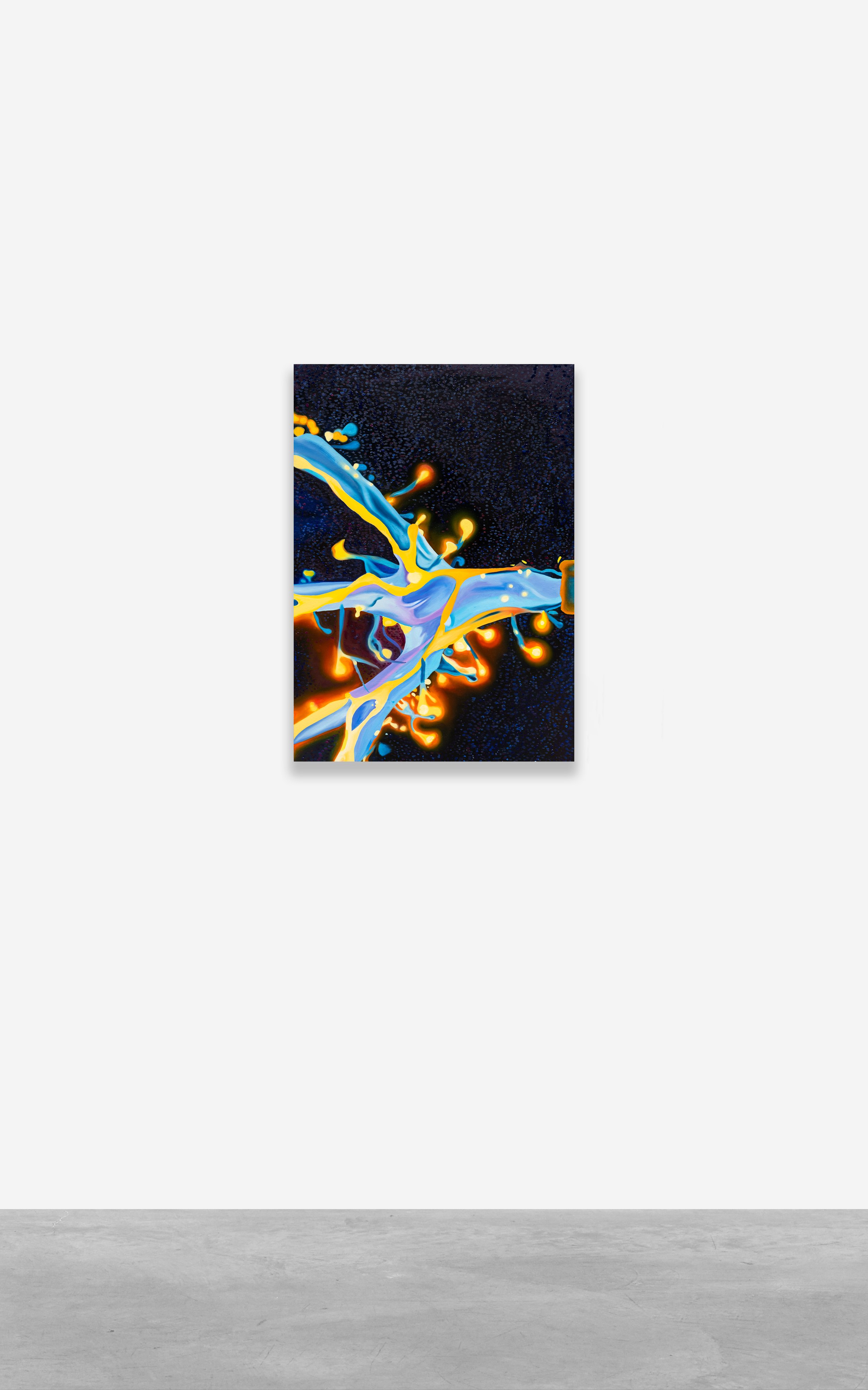
Emergence 02 (2024) is an oil on linen painting, 76 x 46 cm (30 x 18 in), that depicts a neural network in the moment of synaptic transmission. The composition is oriented vertically, with a dense cluster of branching forms at the upper center of the canvas that radiate outward and downward through a series of increasingly diffuse branches, like a tree growing from a central trunk into a canopy of diminishing limbs. The palette is built on a contrast between deep blue and luminous yellow that Tan Mu has described as deliberate and specific: the blue represents the structural environment of the neurons themselves, the dendrites and axons that form the network's architecture, while the yellow represents the neurotransmitters crossing the synaptic gaps, the chemical signals that activate receptors on the receiving neurons and propagate the impulse through the system. This color contrast is not decorative. It encodes a functional distinction between structure and signal, between the permanent pathways that the brain builds over years of development and learning, and the transient electrical and chemical events that flash across those pathways in fractions of a second. The blue forms are built from thick, overlapping strokes of oil paint that create ridges and valleys on the linen surface, giving the neural branches a physical dimension that changes with the angle of the light. The yellow points and streaks are applied more thinly, often as single brush marks that sit on top of the blue ground without sinking into it, so that they appear to hover above the surface, luminous and volatile, as though they might fire and fade in the time it takes to look away and look back.
The linen substrate is visible in the darkest passages of the painting, where the blue paint thins to a wash and the texture of the woven fabric shows through. This is not an accident of application but a structural choice. The visible weave of the linen creates a grid-like pattern beneath the branching forms of the neural network, a geometric substrate that the organic branches of the neurons both follow and resist. At close viewing distance, the weave reads as a grid, regular and mechanical, and the neural branches read as deviations from that grid, reaching across it, curving around it, dividing and subdividing in ways that the grid cannot predict. This tension between the regular and the organic, between the weave of the fabric and the branching of the paint, enacts at a material level the tension that the painting depicts at a representational level: the brain builds its network within the constraints of its physical substrate, and the pattern that emerges from those constraints is both determined by the substrate and irreducible to it. The weave does not explain the branches. The branches do not ignore the weave. The painting holds both in the same visual field and lets the viewer see how they interact.
Odilon Redon produced his noirs, the charcoal drawings and lithographs that made his reputation in the 1880s and 1890s, in near-total darkness. The prints and drawings from this period, which Redon called his "noirs," depict a world of floating eyeballs, strange botanical hybrids, and humanoid creatures emerging from the shadows of an unbounded field. The Eye Like a Strange Balloon Mounts Toward Infinity (1882), perhaps the most famous of these works, shows a disembodied eye, its iris wide and luminous, floating upward through a dark atmosphere past a thin horizon line toward a sphere of light. The eye is both a seeing organ and a seen object, both the instrument of vision and the thing being looked at, and the balloon that carries it is both a technological marvel, the hot-air balloon having been recently invented, and a metaphor for the upward movement of consciousness out of the material world and toward something immaterial. Redon's noirs operate through a logic of emergence that is relevant to Tan Mu's painting. The subjects of the noirs are not described in advance and then rendered. They emerge from the darkness, half-visible, as though the charcoal were a medium not for depiction but for revelation, the image surfacing from the ground like a thought surfacing from the unconscious. Redon himself described the process in terms that anticipate the language of emergence: "My drawings inspire, and are not to be defined. They place us, as does music, in the ambiguous world of the indeterminate."
Redon's noirs and Tan Mu's Emergence series share a logic of visual emergence that operates through the relationship between a dark ground and luminous forms that appear to arise from it. In Redon, the forms are eyeballs, heads, flowers, and insects that float up from a field of charcoal dust. In Tan Mu, the forms are neural branches and synaptic sparks that radiate from a central cluster against a field of deep blue. The structural parallel is precise: in both cases, the image does not sit on top of the ground like a figure on a backdrop. It emerges from the ground, growing outward from a center of concentration toward a periphery of diffusion, and the viewer's experience of the image replicates this movement, starting at the bright center and following the branches outward until they thin into the darkness. But where Redon's noirs are dreamlike and associative, their logic operating by the laws of the unconscious rather than the laws of nature, Tan Mu's neural networks are grounded in the anatomy of the brain. The branching patterns in Emergence 02 follow the logic of dendritic arborization, the process by which a neuron extends its branches outward from the cell body in a pattern that is both genetically programmed and shaped by experience. The painting does not illustrate a neuron. It renders the visual logic of neural branching at a scale where the individual branches can be seen, traced, and followed, and it does so with a specificity that distinguishes it from Redon's more fantastical imagery. The blue forms in Emergence 02 are not generic organic shapes. They are dendrites, recognizable by their branching pattern, their decreasing width as they extend from center to periphery, and the way they terminate in the small bright points that represent synaptic connections. Redon's eye balloon is a symbol. Tan Mu's neural network is a diagram that has been given the weight and texture of paint.
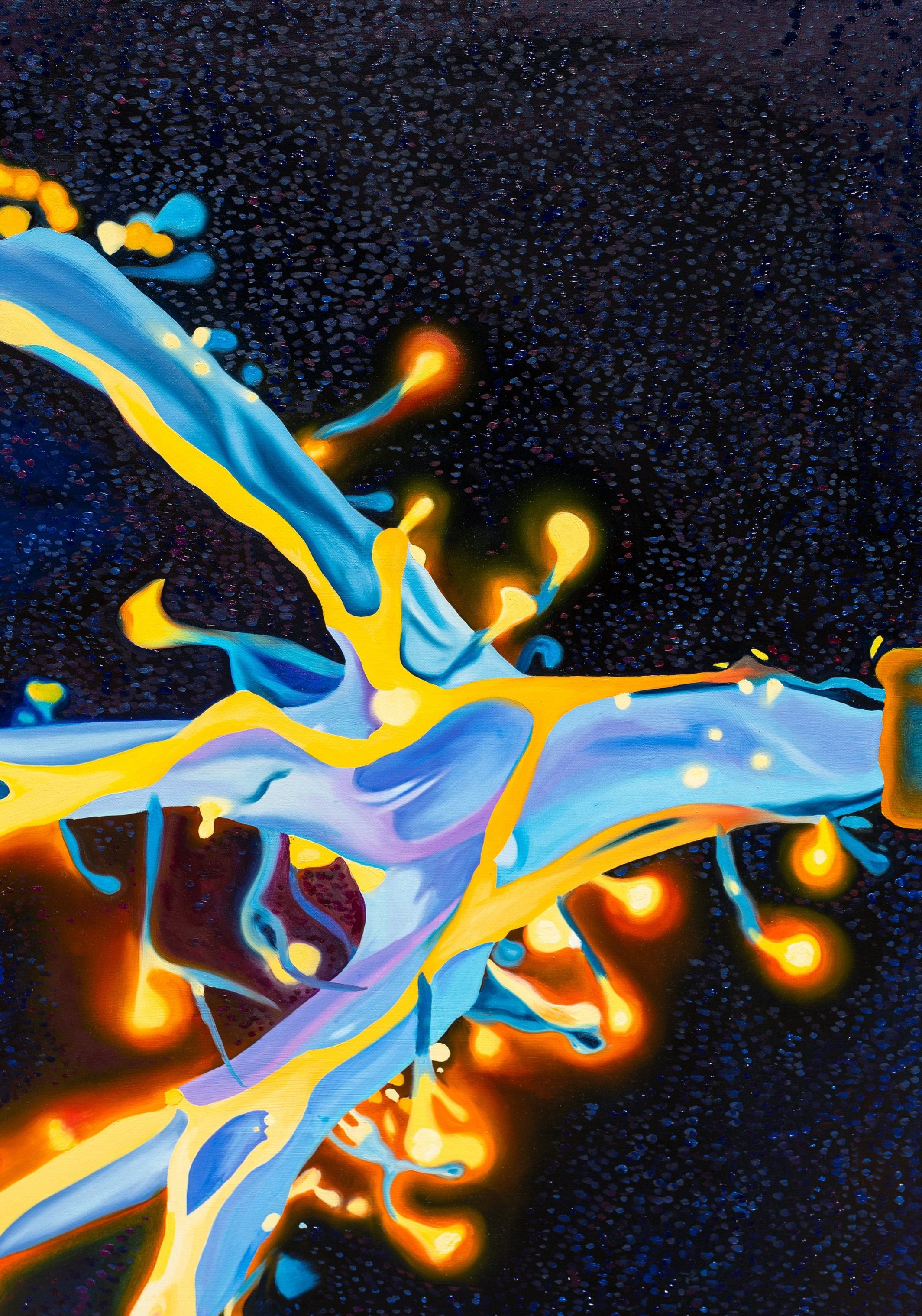
Tan Mu has described the color contrast in the Emergence series and its sibling Synapse (2023) in terms that make the scientific basis of the palette explicit. "The blue tones represent neurons, with axons and dendrites extending outward to form dense networks," she writes. "These branching forms emphasize the complexity and connectivity of the nervous system. Surrounding them are luminous particles that suggest the constant activity of neural signals moving through space." The language is precise. The yellow points are not decorative accents. They are representations of a specific biological event: the release of neurotransmitters into the synaptic cleft. And the blue branching forms are not abstract dendritic shapes. They are representations of the specific architecture of neural tissue, the axons and dendrites that grow outward from the cell body in patterns determined by a combination of genetic programming and sensory experience. The painting encodes this distinction in the materiality of the paint itself: the blue forms are thick, opaque, and sculptural, built up in layers that create physical ridges on the surface; the yellow points are thin, translucent, and applied in single strokes that appear to float above the blue ground. This material distinction is the painting's argument: structure is built slowly, layer by layer, over time; signal is fast, transient, and disappears as quickly as it arrives. The brain is both of these things at once, and the painting renders both in the same visual field, insisting that they are not opposed but complementary, the permanent architecture that makes the transient signal possible and the transient signal that gives the permanent architecture its function.
The connection between neural networks and the structures that Tan Mu paints in other series, from the submarine cable networks of the Signal paintings to the star fields of Horizons and the cosmic mappings of Gaze: Observable Infinity, is not analogical. It is structural. The same branching logic that governs dendritic arborization in the brain governs the distribution of cables along a coastline and the distribution of stars in a galaxy. This is not a metaphor that Tan Mu imposes on the material. It is a pattern that she observes in the material and then renders visible through the medium of paint. "From Atom (2020) to MRI (2021) and Gaze: Observable Infinity (2024), my paintings explore these parallels intuitively," she writes, "linking the microscopic, the cognitive, and the cosmic." The word "intuitively" is important. The structural similarity between neural networks and galaxy clusters is not something she discovered through research. It is something she saw, and having seen it, she painted it, and having painted it, she looked for a framework that could explain what she had seen, and she found one in a research paper on the geometry of AI cognition. The research paper, "The Geometry of Concepts: Sparse Autoencoder Feature Structure," describes how large language models process information in ways that resemble specialized regions of the human brain, and how knowledge is distributed across a multidimensional point cloud, "a universe of concepts" that mirrors patterns found at every scale from atoms to neural networks to galaxies. When Tan Mu read this paper, she recognized the pattern she had been painting for years, and the recognition was not a discovery of something new but a confirmation of something she had already seen.
Anna Atkins published Photographs of British Algae: Cyanotype Impressions between 1843 and 1853, producing what is widely considered the first book illustrated with photographic images. The cyanotype process, invented by John Herschel in 1842, uses ammonium iron(III) citrate and potassium ferricyanide to produce a Prussian blue image on paper when exposed to ultraviolet light. Atkins placed dried algae specimens directly on the coated paper, exposed them to sunlight, and washed the unexposed chemicals away, producing white silhouettes of the algae against a deep blue ground. The results are images of extraordinary beauty and precision: the branching patterns of seaweed, kelp, and diatoms rendered in white against blue, each specimen isolated on its own page, each branching form recorded with a fidelity that no hand-drawn illustration could match. Atkins was not making art. She was making a scientific record, and the cyanotype process, with its high contrast and its monochromatic blue palette, was the most accurate method available for recording the transparent, overlapping structures of aquatic plants. But the images she produced exceed their documentary purpose. The white branching forms against the blue ground produce a visual logic that is identical to the logic of neural networks, submarine cable maps, and star clusters: a set of points and lines, radiating from centers of concentration toward peripheries of dispersion, organized by a principle of branching that is both geometric and organic.
Atkins's cyanotypes and Tan Mu's Emergence 02 share this visual logic, and the shared logic is not coincidental. It is the logic of branching systems, which recurs at every scale of biological and physical organization because it is the most efficient way to distribute resources through a volume. A tree branches because branching maximizes the surface area available for photosynthesis while minimizing the distance between any given leaf and the trunk's water supply. A neuron branches because branching maximizes the number of synaptic connections available for signal transmission while minimizing the distance between any given synapse and the cell body. A submarine cable system branches because branching maximizes the number of landing points available for data transmission while minimizing the total length of cable required to connect them. Atkins recorded the branching patterns of algae because they were the most efficient method of capturing the structures of aquatic plants. Tan Mu records the branching patterns of neurons because they are the most efficient method of capturing the structures of thought. The cyanotype process produces white forms against a blue ground. The oil painting process produces yellow forms against a blue ground. The colors are different. The chemistry is different. The century is different. The branching logic is the same, and it is the same because the material being recorded, whether algae or neural tissue, grows according to the same principles of efficient distribution, and the recording method, whether cyanotype or oil on linen, preserves those principles with a fidelity that makes the underlying pattern visible.
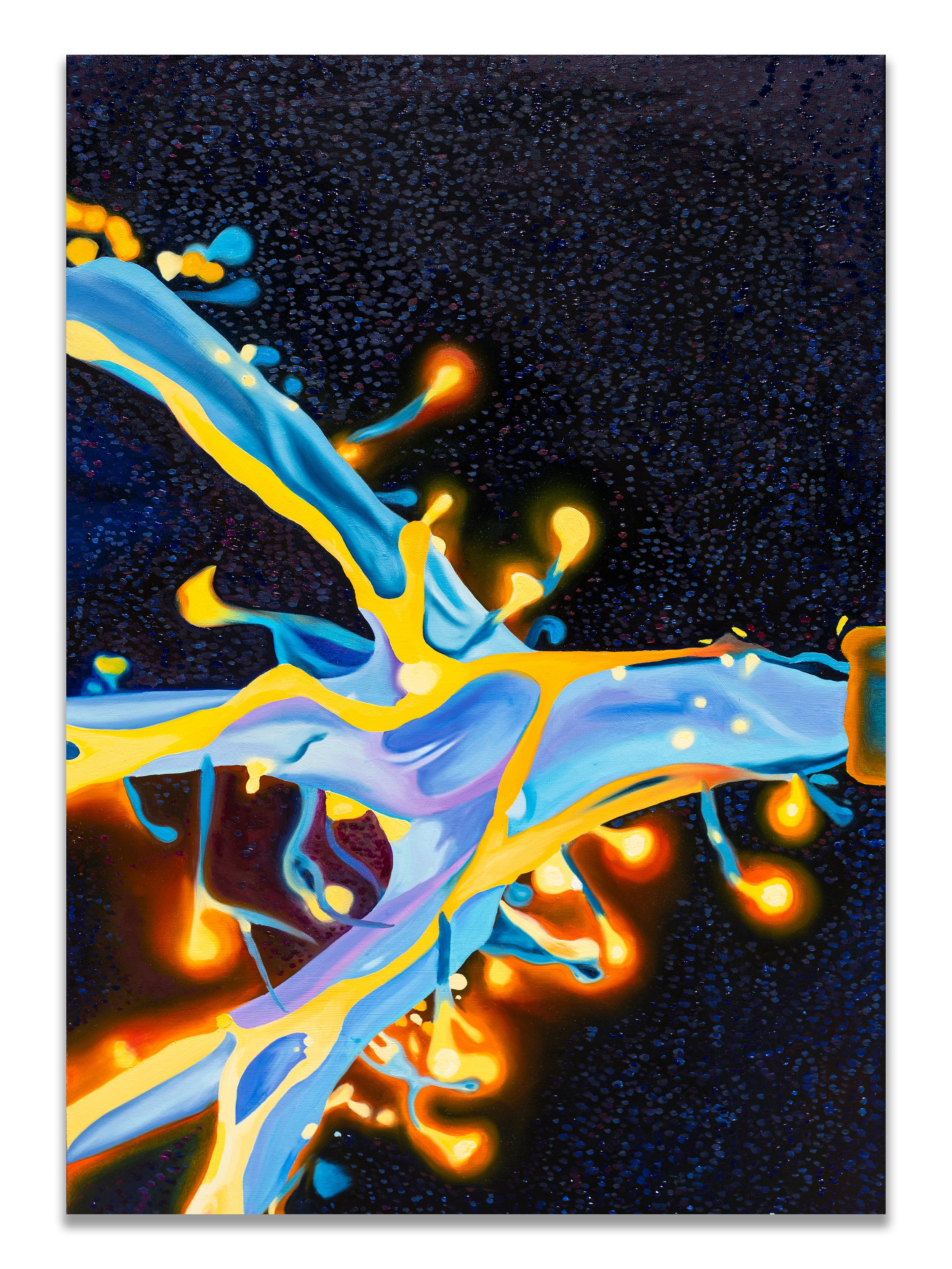
Emergence 02 is a small painting. At 76 x 46 cm, it is roughly the size of a violin case laid flat, and its vertical format invites a reading from top to bottom that follows the direction of the branching, from the dense central cluster of the cell body outward through the dendrites and toward the peripheral points where the luminous yellow marks terminate the branches in flashes of synaptic activity. This downward reading is reinforced by the painting's composition: the densest concentration of blue paint and the brightest concentration of yellow marks occupy the upper third of the canvas, and the branches thin out as they extend downward, becoming sparser and fainter until they dissolve into the dark blue ground at the bottom edge. The direction of growth is also the direction of fading, and this doubleness, emergence and dissolution occurring simultaneously in the same visual field, is what gives the painting its sense of momentariness, the feeling that the neural event it depicts is happening now and will not last. The yellow points, applied in single, decisive brush marks, are the most ephemeral elements in the composition. They do not have the physical substance of the blue branches. They are thin washes of pigment that catch the light when the viewer stands directly in front of the canvas and disappear when the viewer moves to the side, producing a subtle flicker that replicates, at the scale of a painting on a wall, the transient nature of synaptic transmission. The signal fires. The signal fades. The pathway remains. The painting makes this cycle visible not by describing it but by enacting it in the material behavior of the paint: thick where the structure is permanent, thin where the signal is transient, and varying in its response to light depending on whether the viewer is looking at architecture or event.
Danni Shen, writing in Emergent Magazine in 2024, observed that in Tan Mu's practice "technology is not something separate from humanity, but an extension shaped by emotion, materiality, and lived experience." The observation extends to Emergence 02 with particular force, because the painting does not depict a neural network as a technological object. It depicts a neural network as a biological process that has its own emotional and experiential dimensions, and it does so using the most traditional of painterly materials, oil on linen, applied by hand to a fabric surface. The technology that enables the imaging of neural networks, whether electron microscopy or functional MRI, is nowhere visible in the painting. What is visible is the pattern that those technologies reveal, rendered in a medium that predates them by centuries and applied to a surface that is woven on a loom, not manufactured in a clean room. This is the point of the painting's material argument. The branching logic of the neural network does not require a microscope to see. It requires a hand to paint and an eye to follow. The same logic that the microscope reveals at the scale of nanometers, the painting reveals at the scale of brush marks, and the revelation is the same because the logic is the same, and the logic is the same because the principle of efficient distribution governs systems at every scale, from the synaptic cleft to the submarine cable network to the galaxy cluster. The painting does not illustrate this principle. It demonstrates it, by rendering the branching pattern in a medium that is subject to the same physical constraints as the pattern it depicts: the paint must follow the weave of the linen, the brush must follow the movement of the hand, and the hand must follow the logic of the pattern that the eye has already recognized. The painting is not a picture of emergence. It is an emergence, a pattern that generates itself from the interaction of material, medium, and the structured attention of the viewer who watches it unfold.