The Shape That Has No Edge: Tan Mu's Fractal 2 and the Recursion That Makes Infinity Visible
Open any fractal visualization program and zoom into the boundary of the Mandelbrot set. The dark cardioid at the center, the shape that Benoit Mandelbrot called the "most complex object in mathematics," resolves at its edge into a seething coastline of miniature copies of itself, each one surrounded by its own seething coastline of further copies, and each of those surrounded by yet more, indefinitely, with no limit, no terminal resolution, no final magnification at which the boundary becomes smooth. The experience of this zoom is disorienting in a way that is difficult to describe to someone who has not performed it, because the disorientation is not visual but cognitive. The eye understands what it is seeing, a shape that resembles a coastline, with bays and headlands and islands, but the mind expects coastlines to terminate, to give way to open water or flat land, and this one does not. It continues, at every magnification, to produce the same kind of complexity, the same ratio of detail to scale, the same density of incident at every level of resolution. The mathematician who first described this property, Mandelbrot himself, coined the word "fractal" from the Latin fractus, meaning broken, because the dimension of such a shape is not an integer. A line has one dimension. A plane has two. The boundary of the Mandelbrot set has a dimension of approximately 2, which means it is more than a line but not quite a surface, a shape that fills space more thoroughly than any curve but less thoroughly than any area. It is a shape that has no edge. Zoom in far enough and you find not an edge but another boundary as complex as the first, and another beyond that, and another, without end. Tan Mu's Fractal series takes this mathematical fact and translates it into a visual experience that does not require a computer to access. You do not need to zoom. You stand in front of the painting and the painting has already zoomed for you, fixing a single magnification in pigment and presenting it as a composition that is simultaneously a detail of something larger and a whole that contains its own details.
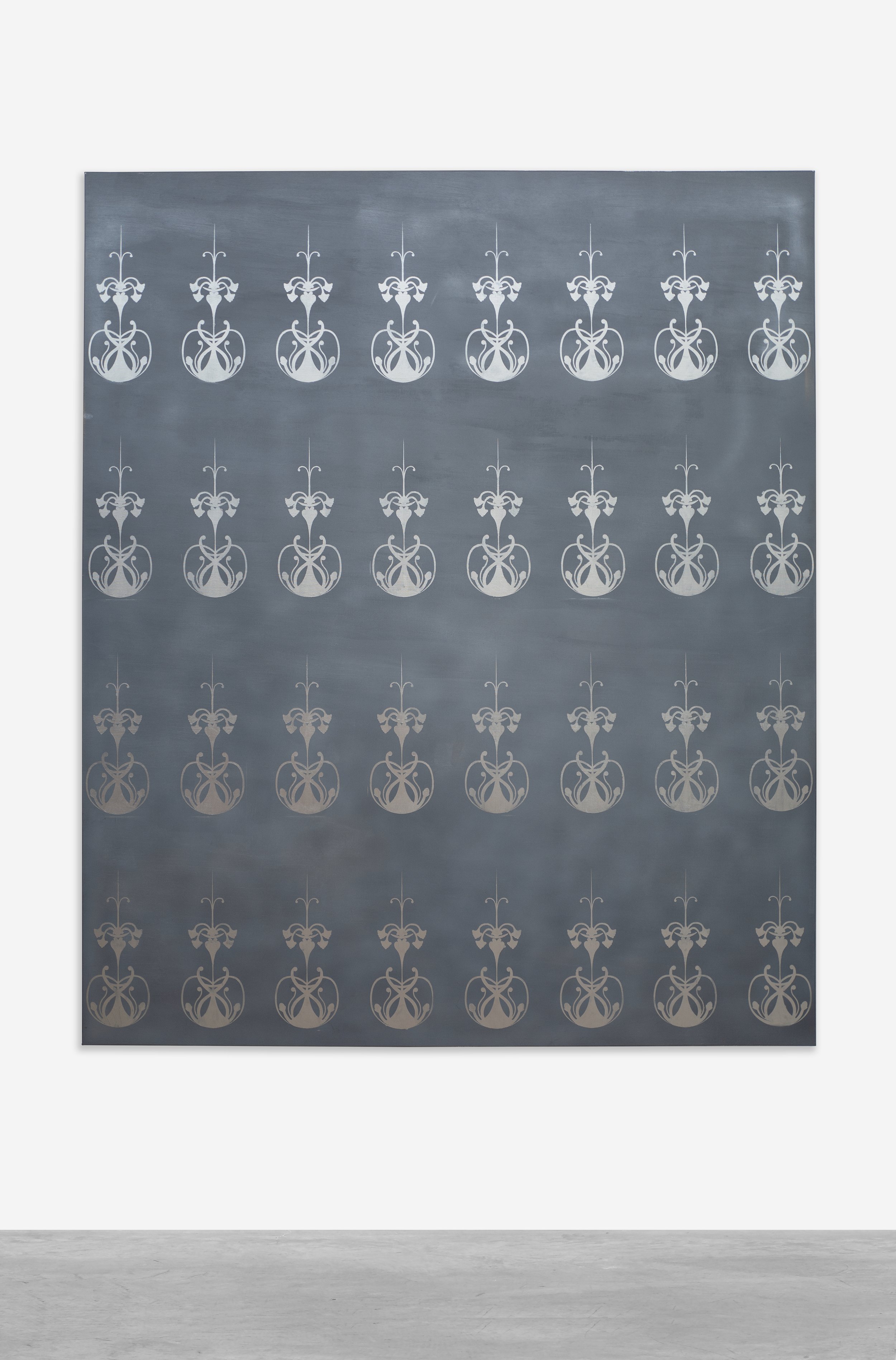
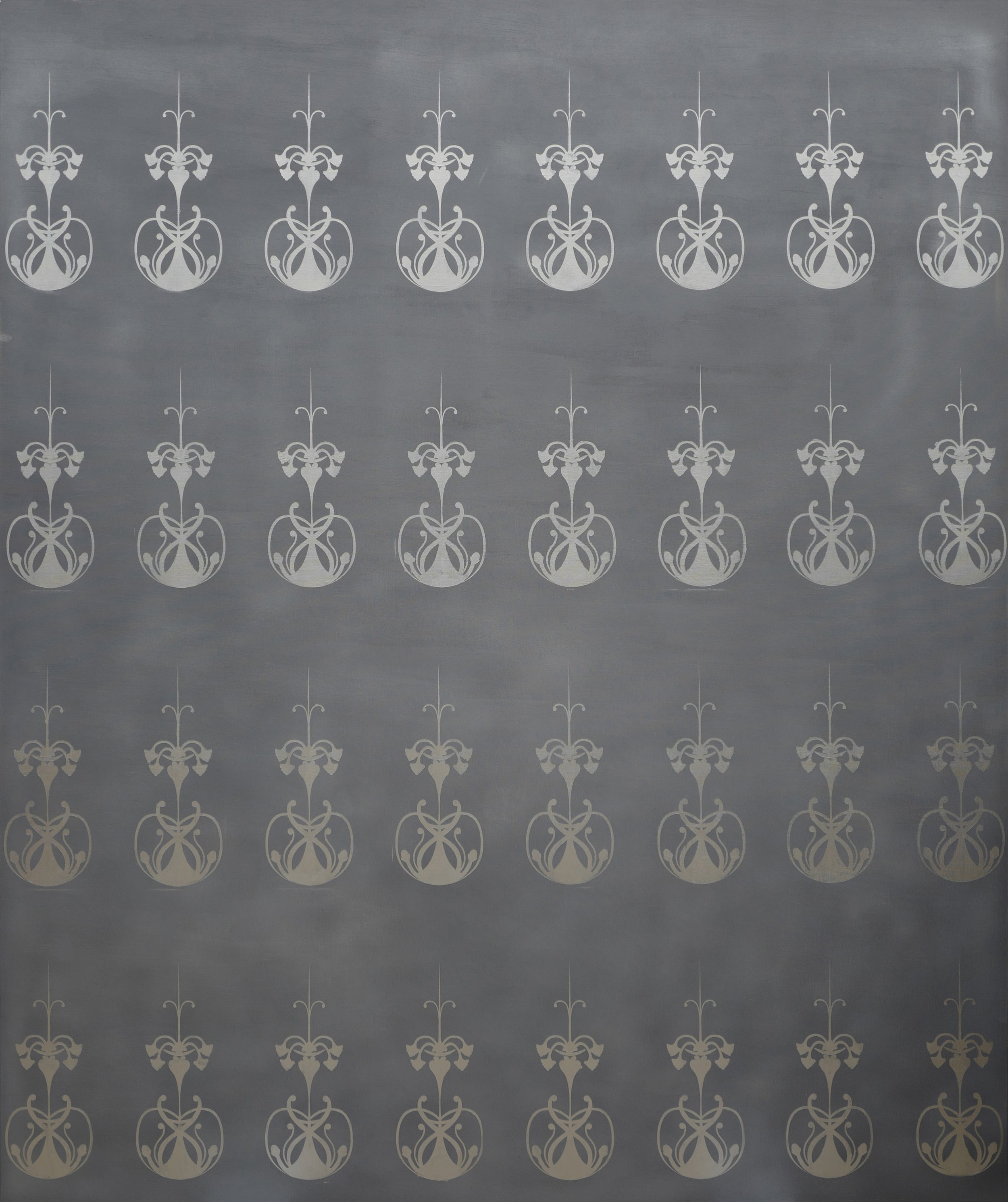
Fractal 2 (2019) is an oil and acrylic medium painting on linen, 182.9 x 152.4 cm (72 x 60 in). It is one of three works in the Fractal series, all produced in the same year and sharing the same dimensions, and it depicts a Buddhabrot visualization, a variant of the Mandelbrot set that maps the probability distribution of trajectories escaping the fractal's boundary. Where the classic Mandelbrot set renders the boundary itself as a dark shape against a colored field, the Buddhabrot renders the trajectories that escape from that boundary, producing an image that resembles, depending on the parameters and the rendering algorithm, a nebula, a biological structure, or the seated figure of a Buddha. The resemblance to the Buddha is not incidental. It is the source of the visualization's name, coined by Melinda Green in 1993, who noticed that the probability distribution of escaping trajectories, when rendered with certain color mappings, produced a form that recalled the meditative posture of a Buddhist icon, a central figure with radiating branches and a surrounding halo of luminous points. Tan Mu describes this resemblance explicitly in her Q&A: "The Buddhabrot, in particular, captured my attention because its distribution of trajectories often resembles the posture and symbolic presence of classical Buddha figures, creating an unexpected connection between mathematics, visual form, and spiritual contemplation."
The surface of Fractal 2 is built from two layers of paint applied in two different mediums. The ground is laid in oil, in broad, horizontal strokes that establish the overall tonality of deep indigo and near-black that serves as the Buddhabrot's visual field. This ground is not uniform. It modulates across the canvas, lighter in the areas where the Buddhabrot's probability distribution is densest and darker in the areas where few trajectories escape, producing a luminosity that appears to emanate from within the paint rather than from its surface. The acrylic medium is applied over this oil ground in a pattern of radiating forms that follow the logic of the Buddhabrot's trajectory distribution. The central form, the "figure" that gives the Buddhabrot its name, is built from a dense concentration of acrylic marks, applied in short, overlapping strokes that create a texture of accumulated luminosity, like a pointillist rendering in which each mark is a trajectory and the total is the probability distribution of all trajectories combined. The branches that radiate outward from this central form are rendered in thinner, more widely spaced strokes that thin out as they extend toward the edges of the canvas, where they dissolve into the dark ground. The color palette is restrained: deep indigo, Prussian blue, and touches of pale gold and white at the points of greatest density. The effect is one of luminous emergence, as though the form were surfacing from a dark medium rather than painted on top of it.
Hilma af Klint began making paintings that she understood as visual representations of spiritual forces in 1906, four years before Kandinsky made his first abstract watercolor and sixteen years before Mondrian arrived at the grid. Working in Stockholm, isolated from the European avant-garde, af Klint produced a body of work that is now recognized as among the earliest abstract paintings in Western art, and she produced it not as a formal innovation but as a method of recording what she saw during séances with the five other women who made up her spiritual group, De Fem. The Ten Largest, a series of ten paintings made in 1907, each one over three meters tall, depicts the cycles of human life from childhood to old age using a visual language of spirals, circles, and radiating forms that bear an uncanny resemblance to the structures that computer-generated fractal visualizations would produce nearly a century later. No. 4, Youth (1907, Hilma af Klint Foundation) is characteristic: a central golden disc, surrounded by concentric rings of pale blue and lavender, from which branching forms radiate outward like the arms of a spiral galaxy or the dendrites of a neuron. The painting is not a representation of any specific natural object. It is a representation of what af Klint called the "astral" plane, a dimension of existence that she believed was accessible through spiritual practice and that she rendered in paint with the same precision and systematic attention that a scientific illustrator would bring to a botanical specimen or a star chart.
Af Klint's The Ten Largest and Tan Mu's Fractal series share a logic of radiating forms that emerge from a central source and extend outward in branching patterns, and the shared logic is not coincidental. Both artists take as their subject the idea that visible forms encode invisible principles, and both render those principles in a visual language that is simultaneously geometric and organic. Af Klint's spirals and radiating lines are not abstractions in the sense of being non-representational. They are representations of spiritual forces that she believed were real and that she had seen, in some sense, during her séances. Tan Mu's fractal forms are not abstractions either. They are representations of mathematical objects that are equally real, in the sense that they can be generated by a deterministic algorithm and will produce the same output regardless of who runs it or where they are when they do. The difference is one of epistemology. Af Klint arrived at her forms through intuition and spiritual practice. Tan Mu arrived at hers through mathematics and computation. But the forms themselves, the spirals and branches and radiating patterns, are structurally identical, and they are identical because the logic that produces them, whether spiritual or mathematical, is a logic of recursion, in which the same principle is applied at every scale, producing a self-similar pattern that has no terminal resolution. Af Klint saw this recursion in the astral plane. Tan Mu sees it in the Mandelbrot set. The eye that looks at a painting by either artist sees the same thing: a form that radiates from a center, branches at its periphery, and dissolves into a field of darkness that is both the ground of the composition and the medium from which the form emerges. Af Klint called it the astral plane. Tan Mu calls it the Mandelbrot set. The painting does not care what you call it. It shows you the form.
The Mandelbrot set is generated by a rule of such simplicity that it can be stated in a single sentence: iterate the function z squared plus c over the complex plane, and color each point according to whether the sequence it generates remains bounded or escapes to infinity. This rule, which can be written in a line of code, produces an object of unbounded complexity, a shape whose boundary is infinite in length, whose detail at every magnification is as rich as the whole, and whose visual properties, when rendered with color mapping, include spirals, tendrils, islands, filaments, and forms that resemble every kind of natural object from ferns to coastlines to neural networks. The paradox at the heart of the Mandelbrot set, and at the heart of the Fractal series that takes it as its subject, is that simplicity of rule does not produce simplicity of outcome. It produces complexity, and the complexity is not random. It is structured, recursive, and self-similar, meaning that the pattern at one scale is replicated at every other scale, with variations that are themselves structured and predictable within the parameters of the generating function. Tan Mu describes this property in terms that connect it to the structure of the universe: "The microscopic structures of atoms or neural networks echo the vast scale of galaxies and cosmic systems. It suggests a deep interconnectedness, where humans are not separate from the universe but embedded within it." The fractal, in her reading, is not merely a mathematical curiosity. It is a model of the principle that governs the relationship between the small and the large, the part and the whole, the moment and the eternity, and the principle is recursion: the same rule, applied at every scale, producing forms that are different in extent but identical in logic.
The concept of ge wu zhi zhi, which Tan Mu has invoked in relation to her work, provides a philosophical framework for this principle. The phrase, drawn from the Great Learning, one of the Four Books of Confucian philosophy, is usually translated as "the investigation of things to extend knowledge," and it describes a method of understanding that proceeds from the close observation of individual phenomena to the recognition of the principles that underlie them. The assumption is that the principles that govern a single thing are the same principles that govern all things, and that by studying one thing thoroughly, you can come to understand the nature of reality as a whole. This is not a metaphor for fractal self-similarity. It is a description of it. The Confucian scholar who investigates the structure of a leaf and finds in it the same branching logic that governs the structure of a river delta, a neural network, or a galaxy is performing the same intellectual operation that a mathematician performs when they recognize that the Mandelbrot set's self-similarity at every scale is a model for the self-similarity of natural systems at every scale. The investigation of a single thing leads to the knowledge of all things because the same rule is being applied everywhere, and the rule produces the same pattern at every scale, and the pattern is the thing that connects the part to the whole. Tan Mu's Fractal series is, among other things, a visual enactment of ge wu zhi zhi: the painting presents a single magnification of a single mathematical object, and the viewer who understands the recursive logic of that object understands, in the same moment, the recursive logic of all the other systems, neural, cosmic, botanical, hydrological, that the object models. The painting does not need to show all of those systems. It shows the principle, and the principle generates them.
Paul Klee taught at the Bauhaus from 1921 to 1931, and during those years he produced both paintings and pedagogical texts that attempted to connect the visual arts to the mathematical and natural sciences. His interest in natural forms, which had been present since his early drawings of plants and animals, deepened during the Bauhaus period into a systematic investigation of the principles that generate those forms: growth, division, branching, and the recursive application of simple rules to produce complex structures. His watercolor Twittering Machine (1922, Museum of Modern Art, New York) is one of the most familiar products of this investigation. It depicts a mechanism consisting of a crank shaft, four wires, and four birds perched on the wires, the entire assembly rendered in the thin, precise line that is Klee's signature graphic style. The machine is not a representation of any actual device. It is a visual proposition about the relationship between mechanical systems and organic forms, between the regularity of the crank and the variability of the birds' songs, between the rule that generates the motion and the unpredictable complexity of the result. The crank turns. The wires vibrate. The birds twitter. The simplicity of the mechanism produces the complexity of the song. The painting is a diagram of emergence, rendered with the lightness of a fable.
Klee's visual propositions and Tan Mu's Fractal series share a concern with the relationship between simple rules and complex outcomes, and they share a method of making that concern visible: they present the rule and the result in the same visual field, so that the viewer can see both at once and understand how one produces the other. In Twittering Machine, the rule is the crank and the result is the birds' song. In Fractal 2, the rule is the iterative function that generates the Mandelbrot set and the result is the Buddhabrot's probability distribution of escaping trajectories. But where Klee represents the rule as a mechanical device and the result as an organic form, using the contrast between the two as the source of visual and conceptual tension, Tan Mu represents both the rule and the result as the same visual phenomenon, because in the Mandelbrot set the rule and the result are the same thing. The rule is the function z squared plus c. The result is the set of points that remain bounded under iteration. The boundary of the set is the visual record of the rule's operation, and the boundary is the most complex object in mathematics. There is no contrast between mechanism and organism in Fractal 2, because the mechanism produces the organism, and the organism is the mechanism made visible. Nick Koenigsknecht, writing in 2025, observed that Tan Mu's practice "does not merely depict scientific subjects but enacts them," and the observation applies to Fractal 2 with particular force. The painting does not depict a fractal. It enacts one, by applying the same visual logic, the same principle of radiating forms that branch and thin as they extend, at every level of its composition, from the dense central cluster to the finest peripheral marks, each one a trajectory, each one a point in the probability distribution, each one a record of the same rule applied one more time.
The scale of Fractal 2, 182.9 x 152.4 cm, is the largest format in the Fractal series and one of the largest in Tan Mu's early practice. The scale is not arbitrary. A fractal visualization rewards close inspection, because every region of the boundary contains as much detail as the whole, and the painting's large format allows the viewer to approach the surface and discover detail that is invisible from a distance. At two meters, the painting reads as a single luminous form emerging from a dark ground. At twenty centimeters, it resolves into a field of individual brush marks, each one distinct in hue and opacity, each one a record of a specific application of the artist's hand. At this distance, the linen weave becomes visible beneath the thinnest passages of acrylic, and the viewer can see that the marks do not follow the grid of the fabric but cross it at angles determined by the trajectory they represent, producing a subtle counterpoint between the regular grid of the weave and the organic branching of the paint. This counterpoint is the painting's material argument: the mathematical rule operates independently of the material substrate, but the material substrate leaves its trace on the result, just as the physics of computation leaves its trace on the visualization that the computer produces, and just as the physics of the brain leaves its trace on the thought that the brain generates. The rule is pure. The result is never pure. There is always a substrate, and the substrate always modifies the outcome, and the modification is not an error but a condition of the rule's existence in the material world. The painting shows this, because the painting is the rule made material, and the material is visible, and the visibility is the point.
The Fractal series occupies a specific position in Tan Mu's chronology. Produced in 2019, it is among her earliest works, and it establishes concerns that will recur throughout the practice: the relationship between simple rules and complex outcomes, the structural similarity between systems at different scales, the capacity of paint to enact the principles it depicts, and the conviction that art is not merely a sensory experience but a method of inquiry into the principles that shape reality. The series also establishes the palette that will become a signature of the practice: deep indigo and Prussian blue grounds, luminous points and lines in gold and white, and a chromatic restraint that produces a meditative register rather than a dramatic one. Tan Mu describes this meditative quality explicitly: "Through restrained color and rhythmic composition, I invite viewers to slow down and enter a contemplative state, where distinctions between time and space, the individual and the cosmos, begin to dissolve." The dissolution of distinctions is not a mystical proposition. It is a mathematical one. The same rule applies at every scale. The same pattern recurs at every magnification. The boundary of the Mandelbrot set has no edge. The shape that the painting presents is a shape that contains itself, and the container is the contained, and the distinction between the part and the whole dissolves not because the painting says it should but because the mathematics insists that it must. The shape has no edge. The recursion has no end. The painting stands still and the zooming continues inside it, indefinitely, in the logic that the paint encodes, in the trajectory that each brush mark represents, in the probability distribution that the total composition renders visible and that will produce, if you follow any branch to its tip and then look closer, another branch, and another, and another, without end.