The Circle That Holds Everything: Tan Mu's Horizons 06 and the View That Made Borders Disappear
On October 24, 1946, a group of scientists at the White Sands Missile Range in New Mexico mounted a 35-millimeter motion picture camera to the body of a V-2 rocket that had been captured from the German army at the end of the Second World War, loaded it with black-and-white film, and launched it to an altitude of 105 kilometers, where the camera automatically activated and recorded approximately five seconds of footage before the rocket fell back to earth. The film, recovered from the wreckage of the rocket by a team that had to dig it out of the sand, contained the first images of Earth taken from beyond the atmosphere. The footage was grainy, jerky, and brief, but it showed something that no human eye had ever seen: the curve of the planet against the blackness of space. The horizon, which every human being who had ever lived had experienced as a flat line where the sky meets the ground, was revealed as a curve, and the curve implied a sphere, and the sphere implied a boundary, a finite surface enclosing a finite volume of air and water, and beyond that boundary there was nothing but vacuum and starlight. Tan Mu's Horizons series, and Horizons 06 in particular, takes this revelation as its starting point and asks what happens to the horizon when you view it not from the ground but from above it, not as a line that limits your sight but as a band that encircles the entire visible world.
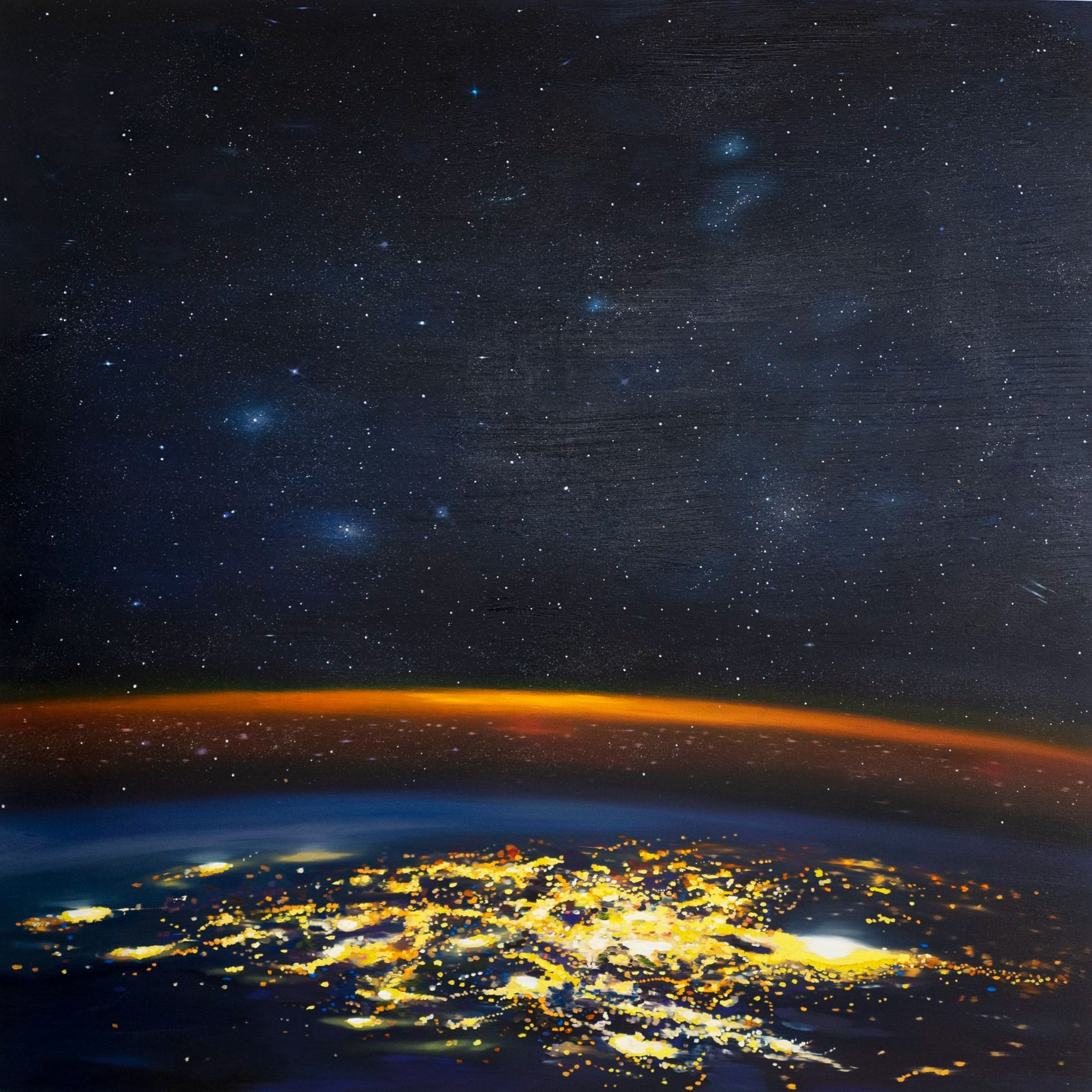
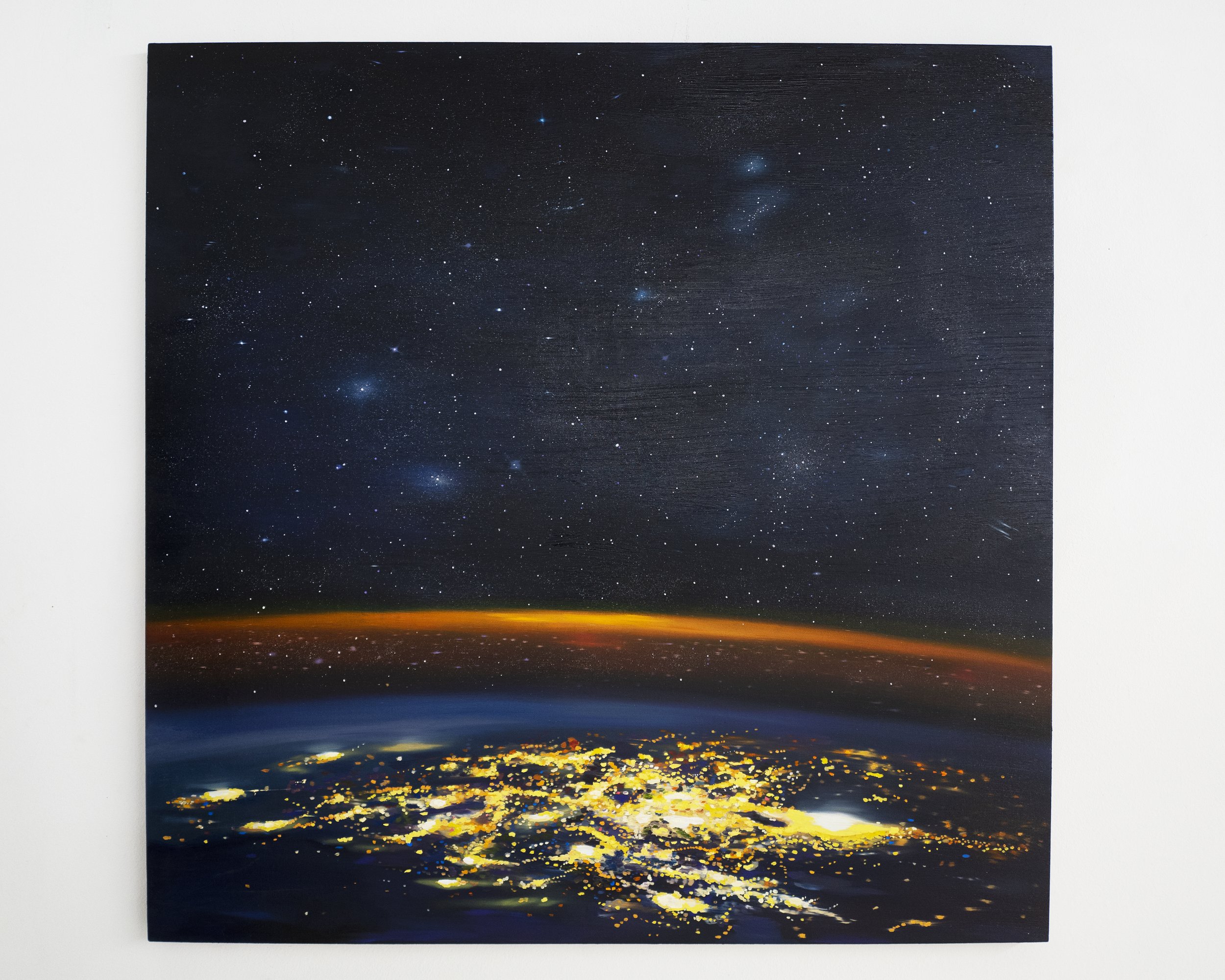
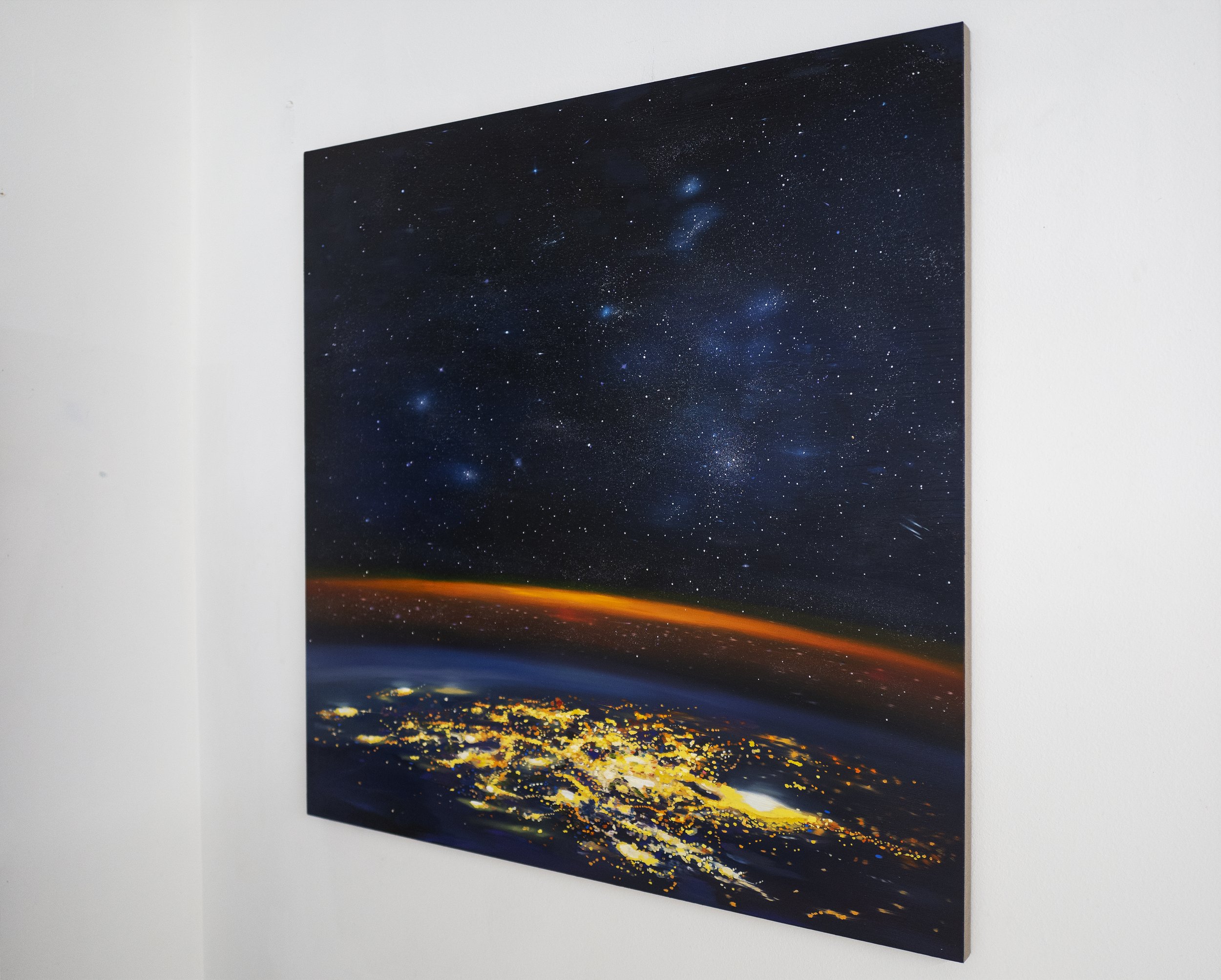
Horizons 06 (2024) is an oil on linen painting measuring 122 x 122 cm (48 x 48 in), a square format that is unusual in the Horizons series and that encodes its central argument in the proportions of the canvas itself. The other paintings in the series are rectangular, with horizontal formats that reinforce the landscape convention of a wide view extending from left to right. Horizons 06 is square, and the square format eliminates the directional bias of the rectangle. There is no left-to-right narrative, no suggestion that the horizon is something you scan across. It is something you look into, a field that surrounds the viewer rather than extending before them, and the painting's composition reinforces this encircling quality by placing the luminous atmospheric band roughly in the center of the canvas, with dark space above and a dark planetary surface below, so that the band reads as a circle or a ring rather than a line. The square format also changes the relationship between the painting and the viewer's body. A rectangular landscape painting positions the viewer at a distance, looking at a view that extends away from them. A square painting of a circular form positions the viewer inside the form, or at least at the center of its field, because the square provides no directional cue about where the view begins or ends. The horizon is everywhere. It surrounds you.
The atmospheric band in Horizons 06 is the painting's central visual event. It runs across the canvas in a gradient that shifts from deep Prussian blue at its outer edges through cerulean, teal, and pale gold at its center, where the warm tones of scattered sunlight mix with the cool tones of Rayleigh scattering to produce a luminous veil that reads simultaneously as atmosphere and as light. The band is not a single stroke or a single gradient. It is built from dozens of thin, horizontal layers of oil paint, each one slightly different in hue and opacity, applied wet over dry in a process that requires each layer to dry before the next can be added. The result is a surface that reads, from a distance of one meter, as a seamless gradient, but that resolves, at a distance of twenty centimeters, into a stack of translucent veils, each one a separate decision about color and transparency, each one visible as a distinct stratum in the atmospheric column that the painting constructs. The technique mirrors the subject. The atmosphere is also built from layers, each one a separate stratum of gas molecules that scatter sunlight according to their own physics, and the gradient that we see when we look at the sky from the ground or at the horizon from orbit is the sum of all those layers, just as the gradient in the painting is the sum of all those brush marks. Below the atmospheric band, the planetary surface is rendered in dark blues and near-blacks, with small concentrations of warm gold and amber that represent city lights as they appear from orbit, clusters of luminous points that mark the places where human habitation has concentrated enough energy to be visible from hundreds of kilometers overhead. Above the band, the star field is rendered as a scatter of points of varying brightness against near-black, following the same point-based visual language that Tan Mu uses throughout her practice to represent distributed luminosity at every scale, from neurons to stars to submarine cables to city lights.
Giovanni Battista Tiepolo spent three years, from 1750 to 1753, painting the ceiling of the staircase in the Würzburg Residence, the palace of the Prince-Bishop of Würzburg in what is now Bavaria. The ceiling, which measures approximately 30 by 18 meters, depicts an allegory of the four continents, with the figures of Europe, Asia, Africa, and America arranged around a central opening in the architecture through which the sky is visible, apparently, because the ceiling has been removed, and the gods and allegorical figures who populate the upper register float in an infinite blue that seems to extend beyond the physical limits of the room. The illusion, which is among the most ambitious and convincing in the history of European ceiling painting, works by exploiting the conventions of quadratura, the tradition of painted architecture that creates the impression of a real opening in a solid ceiling. Tiepolo's figures are not pinned to the surface of the ceiling. They float, or stand on clouds, or lean over balustrades, in a space that appears to continue upward past the physical boundary of the room into a sky that is not the sky of Würzburg but the sky of the allegorical world that the painting depicts. The effect is disorienting. The viewer, standing on the floor of the staircase and looking up, sees a space that appears to be open to the heavens, and the heavens appear to contain not the actual sky but a vision of the world as seen from a vantage that no human body could occupy. Tiepolo's gods look down from above, and the viewer looks up, and the painting mediates between these two positions, creating the impression that the ceiling has been removed and the viewer has been granted a view that should not be possible from inside a building.
Tiepolo's ceiling and Tan Mu's Horizons series share a concern with the vantage that no human body can occupy and the visual experience that such a vantage makes possible. Tiepolo achieves this through illusionistic architecture that opens the ceiling to a painted sky. Tan Mu achieves it through the satellite perspective that opens the canvas to a view of the Earth from orbit. In both cases, the viewer is placed in a position that they could not occupy by natural means and are shown a world that is recognizably the same world they inhabit but that appears different because it is seen from an angle that their body does not permit. Tiepolo's ceiling creates this experience through foreshortening, perspective, and the mastery of light that makes painted figures appear to float in real space. Tan Mu creates it through the gradient, the point field, and the atmospheric band, which together produce the visual impression of looking at a planet from outside its atmosphere. The difference is that Tiepolo's vantage is imaginary and theological. The gods who occupy it are allegorical, and the sky they float in is a symbol of divine order. Tan Mu's vantage is real and technological. The satellites that occupy it are functional, and the planet they look at is the one we live on, with no allegory required. The painting does not need gods to justify its elevated position. It needs a camera, a data link, and a screen, and it translates the image that these technologies provide into a medium that predates them by centuries, with the result that the viewer stands in front of a piece of linen and sees the Earth as a satellite sees it, and the experience of this vision, the sense of dislocation and wonder that it produces, is continuous with the experience that the visitors to the Würzburg Residence must have felt when they looked up at Tiepolo's ceiling and saw the heavens open above their heads.
The satellite perspective that Horizons 06 adopts is not a neutral window. It is a technological construction that determines what can be seen and how it appears. The satellites that orbit Earth at altitudes between 400 and 36,000 kilometers, whether they carry cameras, infrared sensors, or radar imagers, produce images that are determined by their orbital parameters, their sensor specifications, and the processing algorithms that transform raw data into visible images. The city lights that appear in Horizons 06 as clusters of warm gold against a dark ground are visible in satellite imagery because the Suomi NPP satellite's Visible Infrared Imaging Radiometer Suite is sensitive to the wavelengths of light that street lamps, building windows, and vehicle headlights emit, and because the satellite passes over each point on the Earth's surface at the same local time every night, producing a consistent dataset that can be composited into a single image. The atmosphere that appears as a luminous band is visible because the same satellite, or another in the same constellation, observes the limb of the Earth against the darkness of space, and the scattering of sunlight through the atmospheric column produces the same gradient that Tan Mu renders in oil on linen. The satellite does not see what the unaided eye would see from the same position. It sees what its sensors are designed to detect, and what it detects is determined by the physics of electromagnetic radiation, the engineering of the sensor, and the algorithms that process the raw signal into an image that human eyes can read. The painting does not bypass these mediations. It incorporates them. The gradient, the point field, and the atmospheric band are all rendered in a visual language that is continuous with the language of satellite imagery, and the viewer who recognizes this continuity recognizes that the painting is not a representation of an unmediated view but a translation of a technologically mediated one.
Tan Mu describes the satellite perspective as "an extension of the body and an external form of memory," and the description is precise in a way that its generality obscures. The satellite is an extension of the body because it occupies a position that the body cannot reach and transmits data from that position to a screen that the body can see. It is an external form of memory because it stores and transmits images that would otherwise exist only in the moment of their capture, making them available for review, comparison, and analysis at any later time. The combination of these two functions, extended perception and stored recollection, produces a mode of vision that is neither purely immediate nor purely archival but occupies a position between the two, a position in which the viewer sees a view that they did not witness in person but that they can access as though they had, because the satellite has stored it for them. The painting occupies a similar position. It is not a record of a moment that the painter witnessed from orbit. It is a construction, built from source material that the satellite witnessed and that the painter has translated into a medium that does not require a screen, a data link, or a satellite to experience. The viewer stands in front of the canvas and sees what the satellite saw, but they see it as a painting, with all the material presence and perceptual demands that a painting entails, and the combination of the technologically mediated vantage and the materially present surface produces an experience that neither the satellite image nor the painting alone could produce.
Nancy Holt's Sun Tunnels (1973-76) is a land art installation in the Great Basin Desert of western Utah consisting of four concrete tunnels, each approximately 5.5 meters long and 2.7 meters in diameter, arranged in an open X pattern on the desert floor. The tunnels are aligned to the rising and setting sun at the solstices, and each tunnel has a series of holes drilled into its top that project patterns of sunlight onto the interior surface, patterns that correspond to the constellations of Draco, Perseus, Columba, and Capricorn. The tunnels frame the sun at specific moments of the year, and the holes frame the stars at specific moments of the day, creating a double alignment that connects the earthly perspective of a person standing inside the tunnel to the cosmic perspective of the celestial sphere above. The work is a technological instrument in the most literal sense. It is a device for observing the movement of the sun and the stars, and it makes this observation available to anyone who visits the site, without the need for a telescope, a satellite, or any other equipment beyond the body's own capacity to see and to remember. Holt described Sun Tunnels as "a way to observe the cycles of the sun and the stars," and the observation is the work's content as much as its form. The tunnels do not represent the sun or the stars. They make the sun and the stars visible, at specific times and in specific alignments, to a body that is standing in a specific place on the surface of the Earth.
Holt's Sun Tunnels and Tan Mu's Horizons series share a concern with framing the viewer's relationship to the cosmos through a constructed observation point, and they share a method of making that relationship physically available. Holt constructs her observation point from concrete cylinders in the Utah desert. Tan Mu constructs hers from oil paint on linen. Both works position the viewer at a specific vantage and provide a specific frame through which the cosmos becomes legible, and in both cases the frame is the work. Without the tunnels, the sun still rises and sets at the solstices, but it does so without being observed, or rather it is observed by the desert and the rocks and whatever animals happen to be awake at that hour, none of whom are recording the event for later consideration. Without the painting, the satellite still orbits and transmits, but its images are received by screens that require a power supply and a data connection, and they are viewed by people who are sitting in chairs and looking at monitors, which is a different experience from standing in front of a canvas and looking at a surface that has been built, layer by layer, by a hand that held a brush. The painting does not compete with the satellite image. It does something the satellite image cannot do. It makes the orbital view physically present in a room, at a scale that corresponds to the body, in a medium that carries the trace of the hand that made it. The satellite image is a data product. The painting is an object. The satellite image is transmitted, stored, and displayed on a screen that emits light. The painting is built, layer by layer, on a surface that reflects it. The distinction matters, because the experience of looking at a surface that reflects light is different from the experience of looking at a screen that emits it, and the difference is not aesthetic. It is perceptual, and it is the perceptual difference that the painting preserves and the satellite image erases.
Saul Appelbaum, in his 2025 essay on Tan Mu's practice, argues that "the panoramic gaze is not only a visual framework, but also an ethical one," and the square format of Horizons 06 makes this ethical dimension explicit in a way that the rectangular formats of the other Horizons paintings do not. A rectangle has a direction. It extends left to right or top to bottom, and the viewer's eye follows the direction of the extension, scanning across the horizon as though walking along it. A square has no direction. It extends equally in all dimensions, and the viewer's eye finds no natural path to follow and must instead construct its own itinerary, moving outward from the luminous center to the dark edges, or inward from the dark edges to the luminous center, or circling the atmospheric band in a motion that mimics the orbital path of the satellite that provided the source image. This circling motion, which the square format encourages and the rectangular format discourages, is the motion of the panoramic gaze as Tan Mu describes it: a gaze that does not scan but encircles, that does not follow a path but occupies a position, and that from that position sees the planet as a single, bounded system rather than a collection of separate territories. The ethical implication of this gaze is that the boundaries between territories, which are visible from the ground as lines on a map and as walls, fences, and checkpoints on the ground, are invisible from orbit. From the altitude of the International Space Station, the Earth shows no borders. The painting shows no borders either. The city lights cluster along coastlines and river valleys, following the geography of habitation rather than the geometry of political division, and the atmospheric band wraps around the planet in a continuous gradient that does not pause for passports or stop at customs. The square format reinforces this continuity by presenting the horizon as a ring rather than a line, and the ring, unlike the line, has no beginning and no end. It encircles the planet. It holds everything inside it. What it does not show is the borders that divide what it holds.
The square format of Horizons 06 also changes the painting's relationship to time. The rectangular Horizons paintings, with their left-to-right extension, suggest a sequence: the eye enters at one edge and exits at the other, and the passage from entry to exit occupies a duration, however brief. The square format, with its centripetal composition, discourages this sequential reading and encourages a contemplative one, in which the eye circles the luminous band without arriving at a conclusion, because the band has no terminus, and the contemplation has no natural endpoint. This is the temporal mode of orbit, in which the satellite circles the planet every ninety minutes and the view that it provides is continuous, unending, and available at any moment, not as a single image but as a stream of data that can be paused, rewound, and examined at any point. The painting does not pause the stream. It frames a single moment within it, but the square format, by eliminating the directional bias that would make the moment feel like a segment of a longer sequence, makes the moment feel complete in itself, as though the orbital view had always looked like this and always would. This is not an illusion of timelessness. It is a recognition that the orbital perspective, unlike the ground-level perspective, does not change with the position of the observer on the planet's surface. From orbit, the horizon is always there. It encircles the planet. It does not rise or set. It is the constant condition of the view, and the painting, by presenting it as a ring in a square field, makes this constancy visible as a formal property of the composition, not as a narrative about a specific moment in time but as a structural fact about the relationship between a planet and the space that surrounds it. The ring holds. The planet turns inside it. The painting stands still, and the orbiting continues inside it, in the logic of the composition that the viewer's eye enacts every time it circles the luminous band without finding a place to stop.